





On Rendering Time, electronic artist Deborah Martin and woodwind composer Jill Haley craft an immersive soundscape where acoustic and electronic elements merge in a journey through time, space, and memory. Blurring the line between the human and the elemental, each track becomes a precise rendering of a world both ancient and imagined.

Elemental worlds rendered through sound
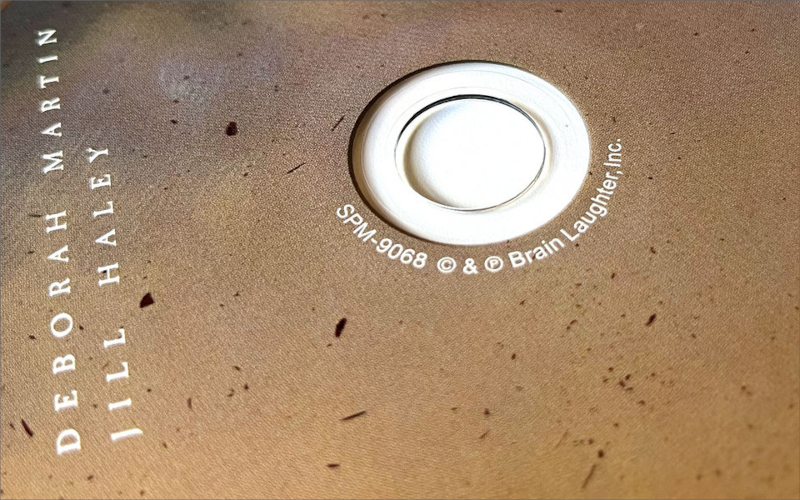
Deborah Martin is a true force, a multi-instrumental artist who, for over three decades, has inspired listeners with her multidimensional electronic sensibilities blending with traditional acoustic instruments which range from all manner of guitars and drums to Garden Weasel and Wooden Cricket. Here, with this collaboration with Jill Haley, Rendering Time, the oboe and English horn, the resonant black cedar flute, the grounding Taos drums, and the otherworldly handpan meet the Yamaha Motif, Roland V-Synth GT, and Spectrasonics Omnisphere. The amazing time machine album graphic design is by Daniel Pipitone.
Sometimes, the line between electronic and acoustic sounds blurs, a deliberate choice that makes you question what you’re really hearing. Rendering Time completes a trilogy, following 2021’s The Silence of Grace and 2023’s Into The Quiet, each a step deeper into the smooth unknown, on a journey that began with nature as its focal point, that has evolved into more inclusive, expansive themes. This wasn’t cooked up by some soulless AI; every note, every shiver, every unsettling echo is the product of human hands, human breath, human intent. This is the artists’ original work, forged by hands and breath, untouched by the eager hum of artificial intelligence.
Even the raw, primal sounds of primordial voice vocalizations and wind breath vocalizations are woven into the tapestry, recorded and mixed with an almost obsessive precision through a Yamaha N12 Console, Rode NT4 Microphone, and Focal Solo 6Be Monitors. That is part of the beauty of this double palette of sounds—they merge. “Render” itself is a word of many faces: to depict, to tear apart, to transform, to yield, to provide. Each musical composition within Rendering Time depicts a specific idea, a thought, separate yet collective in scope.

The album’s opening, “Rendering Time” (5:46) delivers a primal overture. Woodwinds glow, odd percussives echo, and the arrangement, breathtaking in its precision, conjures visions of Martian monks intoning as tumbling worlds go by. The oboe, surely, is alive, its lament resonating in a terrible deep space. Surprises abound – electronic whispers, the keening of woodwinds, and the rustling presence of what must be a legion of strange, small creatures that hum and otherwise intone at dawn. Then, the delicate plucking of harp fingers on strings ushers in “Space Within Spaces” (3:56). The woodwinds lend a warmth, a visceral reality, to the multitude of simultaneous events that, against all odds, refuse to clutter. It feels like a steady, relentless climb, the harp and woodwinds weaving through uncharted territories before turning inward, sparkling with newfound illumination.
From quiet darkness, a sense of great freedom awakens in “Cenote (Place of Deep Water)” (4:30), transporting us gently through watery layers of tiny elements. You can almost hear beings of chilled life, tenacious and impossibly vibrant, growing in a place that shouldn’t exist, a hidden horror cloaked in beauty. “From Source” (5:45) is a true descent into the abyss. It’s darker, with that relentless heartbeat, the flute calling out a haunting melody as time unravels. Strange birds and obscured human forms flicker at the edges of your hearing. The flute here carries the very soul of this experience, a council of ghosts and Martians, its haunting melody weaving as time proceeds.

Through the hardwoods and night breezes ::
The next foundation slowly, terrifyingly, comes together, a sequencer heartbeat that picks up, an interesting flow through the hardwoods and night breezes. “Fitful Dreams” (4:53) thus opens with the rapid, kaleidoscopic drone of flickering flute loops, riding waves into a loop-driven plateau. It’s an interesting flow through hardwoods and night breezes, as new creatures emerge, from those fluting loops, chanting imps signify in the darkness, their presence just enough to be felt, perhaps not.
The ringing strum of metal guitar strings in “Shadow of the Moon” (4:08) weaves with woodwinds and flute into a dark night, an open sky where something is leaping and hopping. The interplay creates favorite moods and sensations, a unique story etched in gold and darkness, a tribute to the moon’s enduring power. It suggests the cosmos is ever-present, the call of the reeds stylized and haunting.
Strings join woodwinds and a liquid orchestra in “This Place We Call Home” (3:12), continually building, raising hills of splendor. Huge vistas stretch to the horizon, a sky bigger than the earth—a cinematic tableau that walks, stands upright, and moves itself at will through a picture of a place long lingered here and beyond. This is where flight opens wider, an unexpected ascent, a woody buzz, a horn, steel strings strummed and plucked, blending concurrent phenomena into an upbeat and positive swell, “Soaring” (3:45) catapults the listener from darkness directly into bright, infinite skies. Guitar strums, now we are above the world, where flight opens your vista wider than you ever thought possible.
Bowed strings and vibrating tone breaths tumble into an orchestral discussion of many voices, covering varied but consistently calm territory. These mixed textures, rich and vibrant, quiet yet sweeping, reach their crescendo in “Secrets of the Talking Trees” (6:58). The woodwinds, truly the trees’ voices, are assertive, calm, sure, and true. They go on, exchanging hidden truths, all the way across the dark, whispering forest.
Themes and memories that cling to you like cobwebs ::
Finally, “Sunlight and Starlight” (4:40) tells of neo-lyrical harp fingers on strings, a tragic tension against warm wonder, a cosmic vista straight up from the mountains, cold clouds, pure sunshine burning, sprinkling tiny, swirling lights from harp strums. The oboe lifts, exposing more new, terrifying territory, with a loving harp of cosmic delight, hand drums, and rushing sensations—returning themes and memories that cling to you like cobwebs.
Deborah Martin revels in experimenting with acoustic sounds, even pushing for “primordial vocal sounds” and “wind breath vocalizations” – improvised, raw, and deeply unsettling, especially in “From Source.” She asked Jill to play a Black Cedar flute for that track, adding another layer of unsettling mystery. Her music is rich, beautiful, yes, but always with that undercurrent, offering crystal clear perceptions and compelling voyages into inner realms of ethereal visions, ancestral legends, and timeless, dreadful places. Jill Haley, a woodwind player, pianist, and composer, brings her own enchanting chilling experiences to the table.
Haley visits National Parks, often as an Artist-in-Residence, composing music about the very ground beneath her feet and the trees reaching high above her, towards the fiery sun in the sky, refreshed by the laughing waters. Her signature oboe and English horn are here, mirroring the infinity of our planet and universe, always transforming, torn apart, rebuilt, and moving to another plane of being. And sometimes, when they merge, you can’t tell where the human ends and the echo of something else begins.
It’s a continuous process throughout infinity, our planet and universe constantly transforming, torn apart, rebuilt, moving to another plane of being. Once an audio or video track is rendered, it’s final. And this final album might feel like the last page of a story, one you might not want to finish. The very title, Rendering Time, suggested by Deborah, carries a profound weight. The word “render” means to depict, to tear apart, to transform, to yield. Each song flows seamlessly into the next, a continuous story of us, our planet, our universe, our solar system – growing, changing, always moving, always in its own time and place, with the lingering scent of something ancient and hungry. Indeed, the lines between electronic and acoustic sounds often blur, a deliberate act of artistry, a journey through the echoes of our past, the tremors of our present, and the whispers of a future yet to be rendered.
Rendering Time is available on Spotted Peccary. [Bandcamp]
Related posts ::
 Deborah Martin & Jill Haley :: Into the Quiet (Spotted Peccary)
 Deborah Martin & Cheryl Gallagher :: TIBET (20th Anniversary Remaster) (Spotted Peccary Music)
 Deborah Martin & Erik Wøllo :: Kinishba (Spotted Peccary Music)
 Time Being :: Hidden Structures (Spotted Peccary Music)
 Rudy Adrian :: Reflections On A Moonlit Lake (Spotted Peccary Music)

![[2View] Koho / Koskenlahti, Mark Reid Bulatović & Simone Spampinato / Fredrik Rasten (Isthmus)](https://igloomag.com/wp/wp-content/uploads/2026/08/koho-kos-mark-reid-2view_feat-75x75.jpg)