

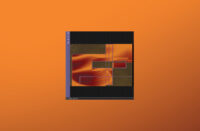
Hello Spiral’s Detached Objects (Moonside Tapes) blends noise, dark ambient, computer music, and musique concrète to defy easy categorization. By severing sounds from familiar meanings, it creates an unsettling atmosphere of estrangement, embodying Viktor Shklovsky’s idea of “making the stone stony” and challenging passive listening.

Actively working against passive listening and perceptive automation
Like most of his extensive discography, Detached Objects, the latest album by Hello Spiral (out digitally and on cassette for Moonside Tapes) is hard to pin down in several ways. Elements from noise, dark ambient, computer music and musique concrète alternate and overlap with an effect of defamiliarization that prevents the listener from being comfortable among the tropes of a genre, sound source, or compositional technique: despite its quiet and almost ambient presentation, Detached Objects actively works against passive listening and perceptive automation, “in order to render the stone its stony quality,” as Viktor Shklovsky put it in his 1926 essay Art as Device, defining the concept of estrangement – an idea that does wonders for understanding this record.
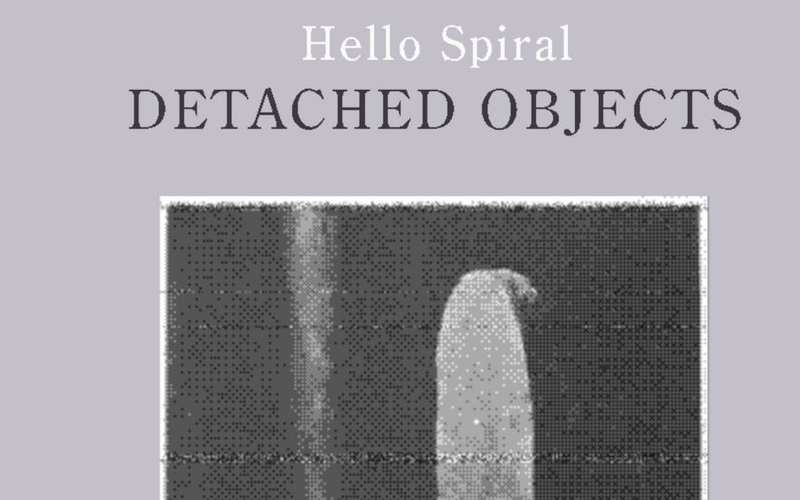
“Frequency Fold” opens the tape with a jolt. A repeating siren moves fast between the channels, finding a rhythm and ending as abruptly as it started. Jarringly, the only extreme-high of energy in the tracklist is fired right at the beginning, but this is only a feint, soon giving way to the massive and dark atmosphere of “Welcome to the Error Dome.” At over 16 minutes, it’s built around multiple spacious drones, with very textural glitch effects in the lower end pushing it over from eerie to downright terrifying. The titular objects are exemplified perfectly by these two tracks: a noisy siren and a cold, slow drone would have emotional associations in real life, referring to something dangerous or at least vaguely alarming, but the addition of computer elements such as naturally impossible glitches and panning, and their juxtaposition in the tracklist, sever the sounds from any imagined connection to our experience, either natural or digital. It estranges them from us. The cover art itself shows a heavy object removed from its purpose and real application: an unadorned headstone, or an Escherian portal playing with lights and shadows, or Shklovsky’s stone itself, in all its stony quality.
The feeling of displacement is strong ::
The following tracks play around minimal sounds of undisclosed origin, glitches kept close to their meaning of error laying out barely-detectable rhythms, and ominous undertones. “Weightless & Minuscule (Pleiades)” offers a literal representation of the effects of mindless perception and automatization, whereby “life is reduced to nothingness and vanishes.” “The Deep End” could be a soundtrack to some uncanny found footage, with its empty room and old neon light hiss as a backdrop to malign swells of sound coming to the listener like war horns over an immense, humid distance. Again, it’s hard to reconcile the connotations of the two main sound components, which would hardly be experienced and in any case, not together. The feeling of displacement is strong and, as vividly described by the press release, this is a soundtrack to disconnecting the signifiers to the signified, only to realize that the referents themselves were devoid of content to begin with.
“Grey Satisfaction” is the final blur frontier: emerging as a field recording of some metal object in a large space, like a key run along a hollow steel tube at the end of a tunnel, it might sound like the most photorealistic track of the set. This is however the only purely digital track in the album, made from editing corrupted audio files from a recovered failed hard disk. In this edge case, the perceived referent is not just far removed or decontextualized – it is strictly non-existent. Another key turned in the lock of estrangement, and whether it’s turned in an opening or a closing is not revealed. (And if this interpretation makes no sense, it is just further proof that the album worked perfectly.)
Detached Objects is available on Moonside Tapes. [Bandcamp]

Related posts ::
 Milieu :: A Spiral In Basalt (Adventurous Music)
 Cult of Light :: The Luminous Spiral (Zazen Sounds)
 Dadub :: How to Shoulder the Radiance of Revelations (Opal Tapes)
 Sytrjv :: Mathematical Objects EP (Point Source Electronic Arts)
 Neuro… No Neuro v/ Volume Objects :: HyperFocused/HyperUnreal EP (Audiobulb)


![[2View] Koho / Koskenlahti, Mark Reid Bulatović & Simone Spampinato / Fredrik Rasten (Isthmus)](https://igloomag.com/wp/wp-content/uploads/2026/08/koho-kos-mark-reid-2view_feat-75x75.jpg)