

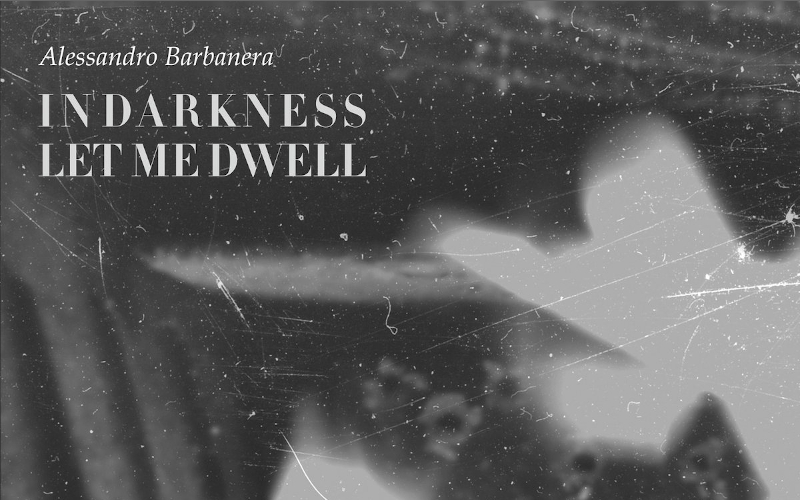



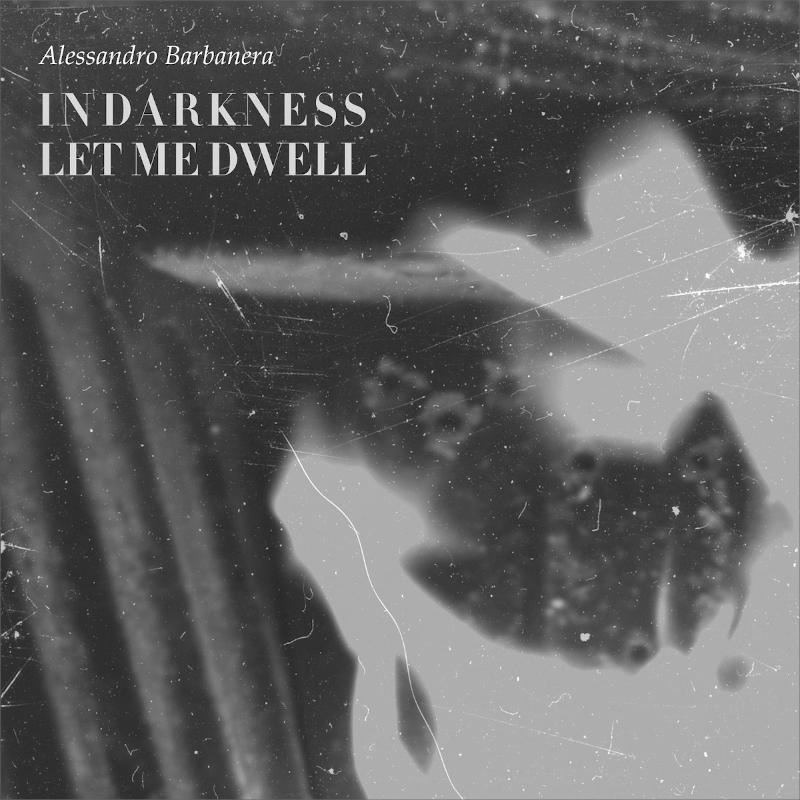
An epic imaginary soundtrack for a fanciful film noir. In a dreamlike and nocturnal atmosphere, filled with rain and decaying sounds, In Darkness Let Me Dwell—available on Owl Totem, a “dark vibes” division of Dronarivm Records—deconstructs, reworks and wants to pay homage to the imagery and clichés of cinema noir.
Contagious spooky sounds
An epic imaginary soundtrack for a fanciful film noir. In a dreamlike and nocturnal atmosphere, filled with rain and decaying sounds, In Darkness Let Me Dwell—available on Owl Totem, a “dark vibes” division of Dronarivm Records—deconstructs, reworks and wants to pay homage to the imagery and clichés of cinema noir. Darkness holds the light that the world has lost. Melancholia is embraced and explored, along with the dreams and illusions of a long delirium. Fittingly indeed does life reward the acceptance of death, inasmuch as to die is to have been alive. I am here for the contagious spooky sounds.
“In Darkness Let Me Dwell” is a quote from Renaissance lutenist John Dowland (1563-1626). The poet Richard Barnfield wrote that Dowland‘s “heavenly touch upon the lute doth ravish human sense.” Dowland is said to have been an otherwise cheerful fellow, who brought a melancholia rare in music at that time, as seen in his gloomy lyrics and affective musical settings, producing popular melancholic songs such as “Come, heavy sleep,” “Come again,” “Flow my tears,” “I saw my Lady weepe,” “Now o now I needs must part,” and of course, our focus here: “In darkness let me dwell.”
Something happened. The titles and audio experience can suggest a story that the listener can make up. I have lived underneath this monastery for over seven centuries. Death and life are traversed in the power of the music. It is not possible to get up at midnight without a will that is renewed, night by night. In the middle of the night I arise to glorify My Lord. Now is the hour for us to rise from sleep. We must be on our guard against evil desires, for death lies close by the gate of pleasure. Run while you have the light of life, lest the darkness of death overtake you. A showdown with inner demons. Who else lives in the darkness? Saint Hu the wanderer watches us, the hermit in the cave listens carefully, dwellers upon thresholds and upon margins attend. Here everything is dark and slow and thick and creepy, floating in uneven vibrations fantastic, big and slow and spooky, eager to get to the satisfying fullness of complete darkness.
Huge sheets of metal vibrating and rumbling ::
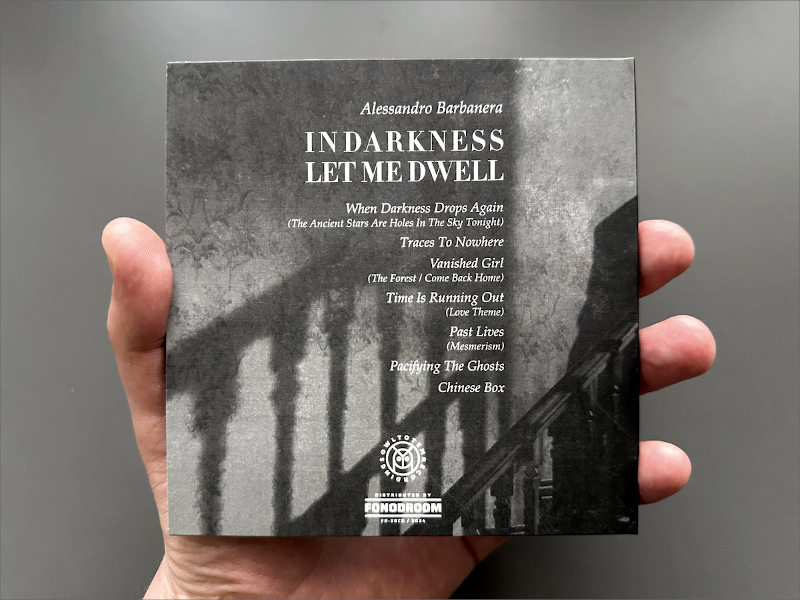
“When Darkness Drops Again (The Ancient Stars Are Holes In The Sky Tonight)” (10:52) opens, and lo, in the beginning, the world comes into the sound of huge sheets of metal vibrating and rumbling, the ferocious fury becomes louder louder then seem to dissipate, then we are in the sky, way up there, soaring. Now the angels of metal have arrived, singing or clanking as the huge sheets of metal coast along in the area, not too close.
The sea has the dark and rather stern, but not cold, blue of that aspect. Marked with the darkness and not the opal tints. The sky is also deep. The most luminous thing is the shining white of an edge of foam, which does not cease to be white because it is a little golden and a little rosy in the lost sunshine. It is, however, the rarest thing, this opening and narrowing under any influences except those of darkness and light. “Traces To Nowhere” (5:20) begins with machines humming and abstract glowing, rumbling at times, sort of waving. I feel a crackling fire or is that the sound of the surface of vinyl being played? The cloud has a name suggesting darkness, divided between grave blue and graver sunlight. The Beeper of Doom wanders past a few times. The moon’s little boat tosses on a sea-wind night. There are no windows of the soul, there are only curtains; and these show all things by seeming to hide a little more, a little less. They hide nothing but their own secrets.
Old rusty metal creaks and shrieks ::
An old unsolved case. A tormented detective on the trail of a missing girl. Someone is in danger. Where are they—all the dying, all the dead, of the populous woods? If death is found in the privacy of the woods, it is all the more a conspicuous secret because it is our only privacy. And yet they keep the millions of the dead out of sight. “Vanished Girl (The Forest / Come Back Home)” (9:20) has a wreath of cautious hums and fading reverberations, dark sadness, old rusty metal creaks and shrieks, a cello is bowed. There are more noises that indicate some kind of activity hidden in the darkness all around me. Again the cello bow is renewed, distant orchestral tones are on the breeze, not quite in focus. Dark humming monks grow from the background to rise up above everything. I heard a tolling of the dismal bell in the distance.
Let us next take up the romantic study of the album. “Time Is Running Out (Love Theme)” (5:24), a peaceful hopeful opening up and rising, things seem like they are not as dark as the things have been here heard recently. An orchestral rising, combinations with strings mostly, maybe some wind, now building and becoming more solid after drifting in the void. Things echo and linger in the atmosphere, before they fade out. Now obey the ringing metal and cowled men humming in a group out there in the dark. A shining cloud is one of the most majestic of all secondary lights, the dawn is silver now, the tone I call ringing metal ascends, reflecting both sunshine and entropy. If the reflecting moon is the bride, then the shining cloud is the friend of the bridegroom. I can feel the melancholic magnetism, I sense that she still waits for me.
“Past Lives (Mesmerism)” (10:12) starts with new crackling in the cave, here comes the singing orchestral choir, singing of the voice of someone in distress somewhere out there. Life is undefended, careless, nimble and noisy. Mesmerism is the study and practice of animal magnetism, which is a theory invented by German doctor Franz Mesmer in the 18th century. Mesmerism identified a plenum or universal principle of fluid matter, which occupies all space. This fluid consists of fire, air and spirit, and like all other fluids, tends to sustain an equilibrium. This fluid matter introduces itself through the gaps, flowing through one body by the currents which radiate to another, as in a magnet, which produces that phenomenon which some call Animal Magnetism.
Hints of atmospheric presences ::
One more time I prepare the dawn. While it is still dark the air senses of my presence, and before the window is opened I am already in the room. The swooping slow and low metal angel choir burgeons only as hints of atmospheric presences. “Pacifying The Ghosts” (3:57) abounds with little fragments that suggest strange textures and wispy glowing breezes. I hear tinkling creaking shimmering rumbling humming, a presence with voices etherializing back in there somewhere, haunting the cathedral or in a big wet cave. In this darkness it makes no difference. I am watching the little lights float about in the cave, this cavalry of light figures flits at nightfall, like an awakening of moths, now letting all of the tension go.
My dreams are fixed upon these themes night by night. They have an urgency, in those dreams, to find the dead in some labyrinth. I am left with a mingling of distress and of persistent incredulous happiness. “Chinese Box” (3:39) closes this tenebrous journey, slow and low and a bit wet. An atmospheric presence formed of little fragments that suggest strange textures and wispy glowing breezes, tinkling creaking shimmering and rumbling. This is within this very same colossal wet cave surrounding us now. I come to the morning light and realize the night is over. I can go now, leave by the chapel and see where the sun is now. Maybe it was all a dream.
Alessandro Barbanera (ROHS! Lontano Series) is a musician, composer, sound artist, guitar maker from Assisi, Italy.
In Darkness Let Me Dwell is available on Owl Totem. [Bandcamp]