


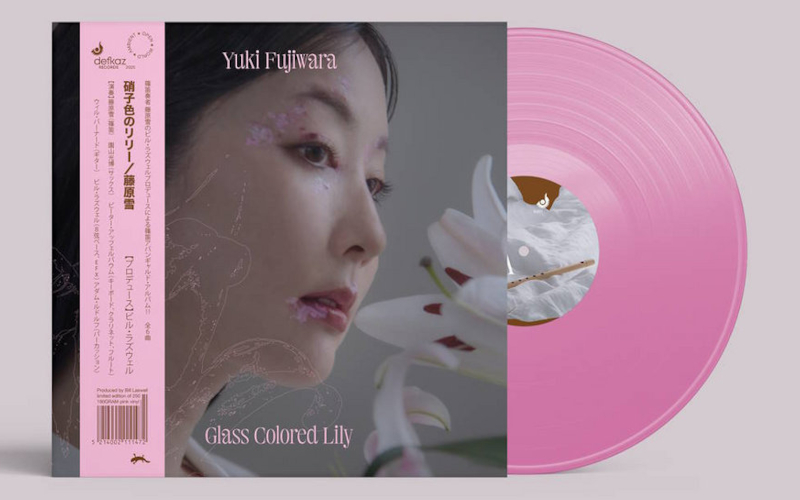


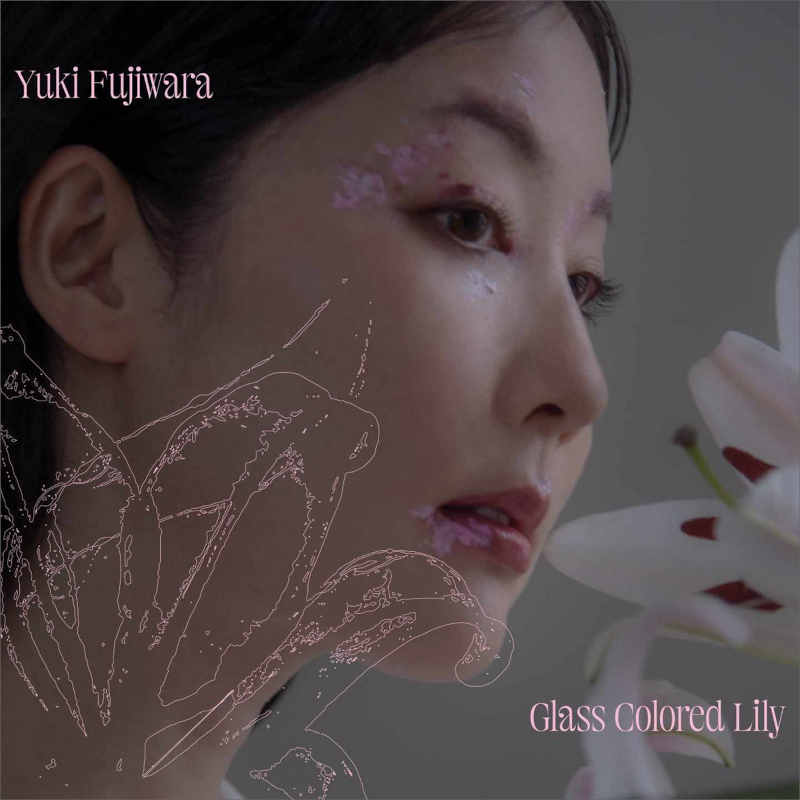
Glass Colored Lilly by Yuki Fujiwara is a unique blend of traditional Japanese flute, jazz improvisation, and Pan-African rhythms. Produced by Bill Laswell, the album creates immersive, cross-cultural soundscapes that invite deep listening and reflection.
The free jazz side of ambient
Glass Colored Lilly is an Ichigo-Ichie, which in English means something like a once-in-a-lifetime sound encounter. Yuki Funjuwara opens up the traditional, ritualist sounding Japanese tones to uplifting improvised swinging pulses and Pan-African rhythms and experiments with the musical potential to create soundscapes rather than merely support rhythm. The shinobue, a bamboo flute, is as high-pitched as a distant cry in Shinto rites, or sometimes low and slow like a forgotten sorrow in folk songs. It creates a strange space. It’s the sound of a sigh, a secret shared across continents, and wanders through sonic trails, down pathways known mostly to dreamers.
Have you ever encountered a sound that spoke to you not only of music, but of a deeper, unseen reality? The sound of Glass Colored Lilly unfolds with the deliberate patience of a desert flower, the union of traditional Japanese breath, thin and ancient, with the improvisational spirit of jazz, touching the edges of the contemporary ambient night’s dream.
This is the free jazz side of ambient, for those who feel it.
A collection of sounds that defy easy categorization, choosing instead to embark upon an adventurous exploration of rhythm, silence, melody, and atmosphere, a journey guided by the deft hand of Fujiwara herself. It’s as though the very elements of sound are transformed, embarking on a journey to a land that exists only in the mind’s eye.
The accomplishments of Yuki Fujiwara extend far beyond the recording studio; she has been appointed as Yamagata Prefecture’s Tourism Ambassador and Tsuyahime Ambassador, and lends her voice as a radio personality at FM Komae. She has graced ceremonies of imperial significance, performed at the global gatherings of the OECD and UNESCO, and brought her unique sonic vision to the United Nations Headquarters in NYC. She is a certified music therapist, she moved to Nepal and served as a music teacher. She also plays the traditional flute.
Cinematic and mysterious ::
Glass Colored Lilly calls to mind images, cinematic and mysterious, like scenes from a life lived in shadows and light. Fujiwara has, with this offering, unlocked the very heart of ritualistic Japanese rhythms, allowing them to dance freely with uplifting, swinging pulses and the vibrant beats of conga and bells.
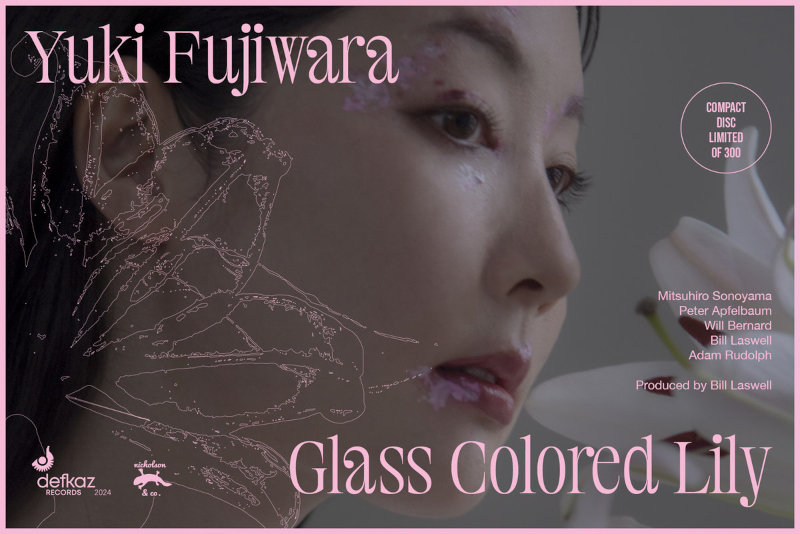
This remarkable achievement was brought to life within the hallowed walls of Bill Laswell’s Orange Music Studio in West Orange, New Jersey, and features a truly stellar cast of Laswell’s frequent collaborators: the versatile Peter Apfelbaum on keys, clarinet, and flute; the boundary-stretching guitarist Will Bernard; the rhythmic genius of percussionist Adam Rudolph; and Laswell himself, a true Nagual of sound, anchoring the sonic exploration with his unique Ovation custom-made 8-string bass.
The spirit flows freely, unhurried, fostering a calming curiosity. The first track, “Gloss Phew” (5:53), is a celestial space jam, the flute leading the way into a sparse, yet paradoxically rich, sound. “Into Thee” (14:52) reaches into an odd range of sounds, an open, free atmosphere. The sound expands, embracing an odd range of instrumental voices where one might imagine birds chirping, responding to each other and countering with full-hearted joy and mystery.
Next, a saxophone and a whistle sound, grounded by a powerful hand-driven percussive foundation, embark on an odd transformative journey, “Like a Water” (Including “Kakeashi” (Kaminoyama traditional, Yamagata JAPAN)) (11:33), finding odd counterparts, blending correlations, asymmetrical percussion. Suddenly, the path veers into the wilderness, and things shift dramatically, slowing to a beatless space.
Teeming with life and energy ::
The flute illuminates, bends, as the hands blaze with an inner fire on track 4, “Remaining, Remaining” (5:34) a powerful current of pounding hand drums, teeming with life and energy, countered by the subtle voice of the wind-blown instrument, one alone yet intertwined with all these others, gently gliding to a warm, fading destiny. The electric strings, saxophone calls and sighs, harmonics like distant bells, the track glides gracefully to a warm, fading conclusion.

The reed drones, evoking a feeling of slow suspense, an incremental tension, as more electric string textures flow through, “Night’s Dream is True〜Ai no-Uta” (13:45). A series of events unfolds within the sound of an old dollhouse, her haunting voice gently intoning and sustaining, suspending moments as something new awakens, exploring each sound with cautious freedom. Something new awakens, cautious, exploring each sound in free time. Dark and quiet in places, yet with an unseen energy, it possesses a peculiar, enjoyable quality, with echoes of haunted houses, suspenseful and deliberate, sparse in places, yet layering into richer textures. This track is a strange, enjoyable slow circus of different characters, encountering one another and weaving a compelling narrative. We all walk hand in hand by candlelight on the path, as more voices join, singing variations on “ai no uta”, until she is alone. A haunting theme, a primal sound, slowly, with feeling.
The distinct buzzing of what sounds like an African mbira, a type of kalimba sometimes known as a thumb piano, provides a melodic counterpoint to the flute’s narrative, “The Red Devil Who Cried” (3:14). The flute holds the narrative as the beat buzzes melodically, a dance to conclude the journey.
A form of alchemy ::
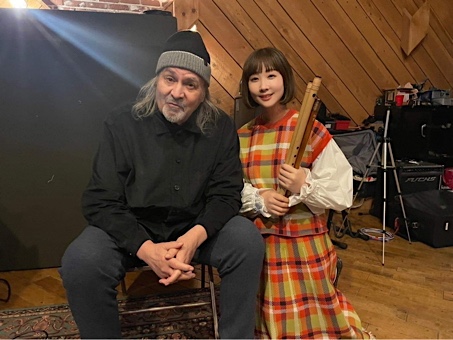
Bill Laswell, the album’s producer, shares some thoughts about this project. “Today, we were transforming all the elements into sound….I think this recording speaks that way.” He adds, “This is a recording of very unique musicians. Everyone had a deep understanding of music from different cultures, including Japan. Think of it as a new cultural ensemble with everyone bringing their experiences to the overall sound. Japanese musicians – Yuki and Mitsuhiro brought their very own strong statements and presents. I should say this session was a Ichigo-Ichie: once-in-a-lifetime sound encounter.”
This music is a form of alchemy, a crafting of soundscapes where the very air breathes music. Glass Colored Lilly is an experiment with the very potential of sound itself, conjuring soundscapes as vast and mysterious as the dreaming mind. This is the beginning.
Mix-translation: Bill Laswell
Engineering: James Dellatacoma
Recorded & Mixed at Orange Music Studio, West Orange, NJ
Mastering: Masahiro Tabayashi (Nippon Columbia.Co.,ltd.)
Thanks to Ryo Togawa
Management: Yoshinori “YOSHI” Watanabe (Nicholson & Co.) Japan
Photographer: Madoka Shibazaki / Hair and Make Up: Haruna Sato
Coordination: Yoko Yamabe
Graphic Design: ajax19
Supervised by Iannis Koufaelas
Glass Colored Lilly is available on Defkaz. [Bandcamp]