


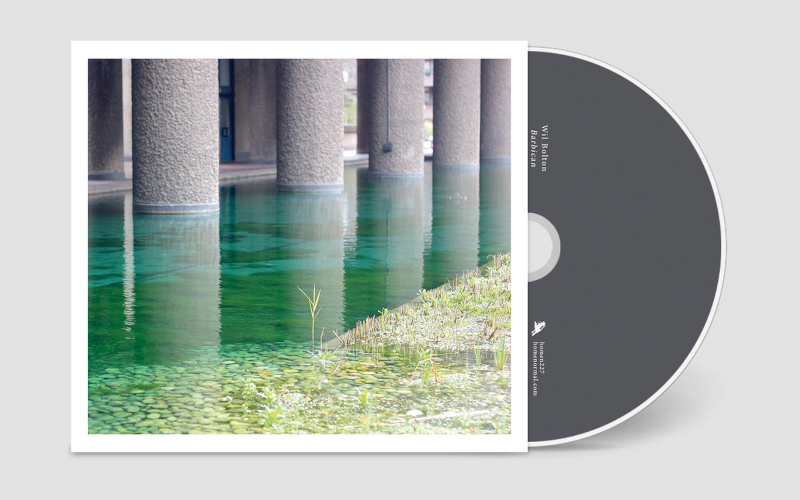



Celebrating the opportunities to perform with vintage electronic music technology, not for dance, not for sleep, just for the art of listening, Barbican is a new album by Wil Bolton. The project draws inspiration from the Brutalist architecture and cultural ecosystem of London’s Barbican Estate and Art Centre and is performed on period electronica.

Resonant concrete and reverberant ambient public spaces
Barbican sits at the intersection of place, history, and electronic experimentation, offering a focused and textural work that reflects on architecture as both physical structure and lived environment. Brutalist architecture emerged in the 1950s–1970s, and is defined by raw, exposed concrete (béton brut), massive blocky, or modular forms, and a strict, minimalist aesthetic. These buildings prioritize structural honesty, featuring unpainted surfaces, functional geometric shapes, and a lack of ornamentation, creating an imposing and, at times, monolithic appearance. The sound tells the story.
Celebrating the opportunities to perform with vintage electronic music technology, not for dance, not for sleep, just for the art of listening, Barbican is a new album by Wil Bolton. The project draws inspiration from the Brutalist architecture and cultural ecosystem of London’s Barbican Estate and Art Centre and is performed on period electronica. These stark basic early electronic sound generators, historically significant electronic sounds are used to shape immersive, sculptural compositions that mirror the Barbican’s utopian ideals, scale and presence. Built around field recordings captured on site, the work weaves together the everyday acoustics of the complex — its elevated walkways, resonant concrete and reverberant ambient public spaces — with the expressive potential of vintage electronic instruments.
The album was recorded during artist residencies at Electronic Studio Radio Belgrade in Serbia and Elektronmusikstudion in Stockholm, Sweden. Environmental sounds recorded in the Barbican Estate and Centre, London. EMS Synthi 100 synthesizer recorded at Electronic Studio Radio Belgrade, June 2024. Buchla 100, Buchla 200, Serge and Erica SYNTRX synthesizers and AKG BX20 spring reverb recorded at EMS (Elektronmusikstudion), Stockholm, September 2023 and October 2024.

Imagine solid, thick concrete walls, deep-set to create dramatic, contrasting shadows. “The Yellow Line” (12:02) uses repetitive, angular, harsh block-like shapes to predict a bright transversive path or trail through the void, using mostly electronics. The feeling is rather dark, mostly, with an odd twisting and turning melody. Is that the rushing sound of a subway station nearby? Somewhere upon an extensive elevated promenade, I hear slow repetitive orchestral tones, repeating forever, slowly building up and getting louder, a gray color palette, not much color, lots of textures. “Lost on the Highwalk” (9:30), out here the time is different when you are lost.
In places on the album, such as parts of this next track, I am reminded of radio conversations or monologues on the shortwave radio, strange voices calling from somewhere far away. “The Circle Below” (5:05) reminds me to watch the dial and accept the abrupt deeper transport onto more hypnotic electronica, with more tones and textures, more melodic human noodling. “Turquoise Artifice” (5:00) brings watery drips, buzzy bass and keyboard drones, rain trickle sounds, light sprinkles and tinks, under a hissing spray. Slowly, through the distant early morning traffic sounds, here come the warm buzzes, in cut up loops, with wandering warm easy electronic keyboards, “Frobisher Crescent” (10:45). The original Frobisher Crescent is a distinctively dramatic semi-circular shaped, nine-level Brutalist building within the Barbican Estate in London, with links to the Arts Centre and features residential flats on upper levels, with office space below, completed around 1982. The design was inspired by the nearby 18th-century Jewin Crescent, which was destroyed during the Blitz.
The Frobisher Crescent is named after Elizabethan privateer Sir Martin Frobisher. Martin Frobisher was a British freebooter who went looking for the North-west Passage on three occasions, exploring the land that would eventually become Canada. Subsequently, Frobisher became a licensed pirate and plundered French ships off the coast of Africa, creating a legacy of daring achievements, but also of killings and kidnappings. He was later knighted for his service in repelling the Spanish Armada in 1588.
Barbican is available on Home Normal. [Bandcamp]