





Shoegaze has always been a genre shaped as much by distortion as by definition. Coined—and complicated—by the British music press, the term has been embraced, rejected, and debated by the very bands it aimed to describe. In Shoegaze, music writer Ryan Pinkard explores this hazy history with clarity and curiosity, tracing the genre’s roots through its sounds, scenes, and stories. As a longtime fan, I found his account both illuminating and rewarding—a vital look at a style often heard but rarely explained.
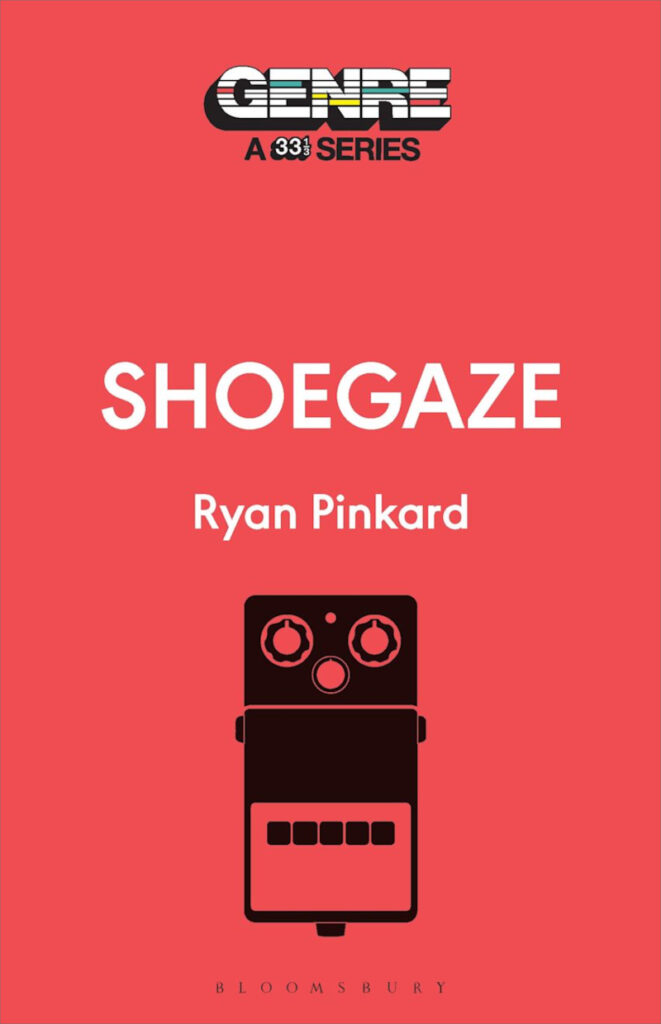
A clear-eyed history of a genre shaped by noise and ambiguity
The thing about shoegaze is how much of it, as a genre, was a product of the British music press. As a music writer, Ryan Pinkard’s highly edible history of the term and its history, sometimes rejected by the bands who it was supposed to describe, but just as often embraced, gives much to ponder and think about in terms of the relationship between those who chronicle music and those who make it. Pinkard does that amply well, and takes us back to a time in the eighties and early nineties when pedal driven guitar music and hushed vocals sparred with distortion to bring new avenues of exploration for those tired of the same old rock.
For full disclosure, I want to mention that besides his own writing Pinkard does a lot of work as an editor, and he edited my book The Radio Phonics Laboratory. This review however was my own idea. Shoegaze has been a genre I love, and it was nice to be finally read a history of it, the first of its kind. Pinkard did us all service by talking to and get into the head space of the musicians, writers and label runners who brought the music to us. I wanted to extend that sense of gratitude I felt in reading the story of shoegaze, by writing this review and letting the community around Igloo and other readers know about his book.
Voices in the Haze ::
Most of the old shoegaze Scene is all here, and well represented in the book. Whether they were a Scene or not seems to depend on who you ask, and different opinions are present. More on that later, but some groups are conspicuous by their absence. Regarding that, one of the best lines in a book chock full zingers comes from the acknowledgments section at the end, where Pinkard says thanks to My Bloody Valentine “for ignoring my emails.” Thus Kevin Shields, Debbie Googe, Colm Ó Cíosóig and Bilinda Butcher are all absent from the oral history presented in the book. That’s a shame, whether you love them or not, because their influence has been so pervasive across what became shoegaze and indie rock in general. It would have been nice to hear from them, but I guess that’s not how they roll.
That absence is made up for by the voice of Robin Guthrie who can been seen, along with Elizabeth Fraser, as the other progenitors of the style via the groundbreaking sounds of the Cocteau Twins. Sadly, Fraser’s voice is absent from the telling. Her unique way of singing helped to inspire the shoegaze vibe just as much as the ghostly strumming of Guthrie’s guitars. It would have been nice to hear from her too.
Lucky for Pinkard and us, many others he contacted were willing to talk, and for the most part they come across as congenial, friendly and even supportive of one another, which is great to hear and read about. Making a life in the arts is hard enough without internal competition from people who could be helping one other in the spirit of mutual aid.
Members of Slowdive, Lush, Ride, Spacemen 3, Swervedriver, Chapterhouse all participated to tell their stories as did journalists from Melody Maker and NME, and a few label heads. I’ve always found it impressive the way oral histories of music are constructed and woven together from the interviews of many people into a cohesive narrative around clusters of topics. That is the approach Pinkard took here, interspersed with his assessments and astute observations, insights and history making this a wonderful story.
When Pinkard started the book, he didn’t really have an idea of what the term shoegaze even really meant. He knew some of the famous albums, such as Slowdive’s Souvlaki, and Loveless from My Bloody Valentine, who he calls the “sacrosanct sultans of shoegaze”. (To be honest, when I bought that particular album from Shake It! Records in the early oughts, I really wanted to like it, and I do like a few of the songs, but given my tastes, I really should have liked it. I never could get into the album as a whole, and eventually sold the CD back to them. The same was not true for my copies of the Cocteau Twins and Slowdive albums I picked up back then. Perhaps my opinion of MBV would have been different if I’d had the chance to see them live. Perhaps I should give them and their other albums a few more spins.)
Shoegaze and the Power of the Press ::
Pinkard is an American and wasn’t reading the British music press when these and other albums came out, so his impression of what made up shoegaze was rather vague, as it is for many other newcomers to the style. He asks a question a lot of us have wondered “what the hell is shoegaze?” To me, that makes him the perfect kind of investigator. A person with musical curiosity who wanted to go out and see what this genre was all about beyond the most talked about albums and bands and report back to us other music fans on what he found. That journey is what makes up the course of the book.
Pinkard starts by digging into the progenitors of the genre, bands like Jesus and the Mary Chain who were doing their own thing with the trappings of dissonant post-punk and acidic alternative, and whose feedback drenched explorations inspired many other musicians. MBV’s You Made Me Realise was another watershed moment he touches on. (Listening to this one again as I work on this review, I do like the songs pounding drums and bass, the blistering distortion, the blurred and buried vocals). This gave another template for others to start fucking around with themselves, and see if they could put their own spin on the sound. As did the Cocteau Twins gorgeous melding of effect laden guitars and hushed female vocals blended in vortex with reverb and drum machines.
A lot of the bands who came afterwards had been inspired by this (holy?) triumvirate of Jesus and the Mary Chain, MBV and Cocteau Twins. The energy within independent music everywhere has been predicated on a notion that if someone else could make something, they could also do it themselves. May that kind of inspiration long live on, as new chains of influence are continuously formed and forged.
As new bands started forming and messing around with the very important array of guitar effects pedals in their practices and performances, they laid the tracks to tape, made records, and gave something new to music press to talk about, something they could toy around with and let out the mercurial writerly spirit.
Chroniclers and Creators ::
In the 80s and 90s it was only shows like John Peel on the BBC in England where stuff of this nature got played on the radio, and that was during the later portion of his show. John Peel was the major lifeline for any alternative minded listener in England. I’ve heard so many stories of fans taping his shows religiously to get the latest cuts. The other lifeline was the music press. Without much other airtime, and only rare mentions in mainstream media, fans looked to New Music Express and Melody Maker to see what the writers thought about new records coming out of the underground.
As journalist Kitty Empire noted in an article in the Guardian, “Those of us who cut our teeth on the weekly music press are, by nature, bullishly nostalgic for the days when NME and Melody Maker sold hundreds of thousands of copies, reputations and heated pub exchanges hinging on their contents. Music and its chronicling seemed like the central whorl around which the universe spun. The tone alternated between bumptious certainty and shit-stirring mischief, in-jokes and crusading.”
The part of his book that digs into the “Almighty Music Press” was intensely captivating to me: how the pronouncements of the press started making the rounds, getting fans into a frenzy, and irritating the hell out of some of the people who were just trying to make music they like, and that others happened to like, while delighting others. As an American who came of age in the nineties it is hard to imagine this level of excitement and discourse around music magazines. Sure, we had Rolling Stone and Spin. If you were lucky, you had access to an alternative paper like the Village Voice but there are huge swathes of the population who don’t live in New York.
For those of us in the Midwest, we searched for the music columns in smaller alt weeklies, local zines and larger national zines like Maximum Rocknoll (if you liked punk) when we could our hands on them. Unless someone handed you a cassette or told you to check out a certain band, or you lived in a place that had decent college or community radio, there wasn’t much other way to hear independent music. Yet even as I read about music here and there, I never remember it being as rabid as what Kitty Empire remembers, or what Pinkard describes. I guess that is the difference from growing up in the Midwest and being in London. Of course, when music blogging took off in the oughts, I do remember lots of shade getting thrown around online. The closest thing I can recall to the energy around shoegaze, was all the hype about hauntology, which still seems to be haunting us today. But that’s another story.
The voices that defined a genre ::
Another short chapter is devoted to “The Scene That Celebrates Itself” a phrase that came out the clacking keys of NME and Melody Maker writer Steve Sutherland. Another brief bit is on how the name shoegaze was invented in the first place, from the word shoegazing coined by the late Andy Ross. The music itself is what is at the heart of the book. Yet it is hard for listeners to hear music without record labels and distribution to bring us the music. There is a chapter devoted to Creation Records and 4AD and later on, the head of label Sonic Cathedral. These days Sonic Cathedral dubs itself as “the label that celebrates itself” showing just how long the words of the almighty music press linger in influence.
Whatever the press was saying, whoever they were praising or deriding, it was the bands themselves, the music they made, and the special bond they formed with their listeners and fans that made shoegaze such a shiny spot in independent music. The story of the EPs, (there were lots of EPs) of the albums, of the songs, of the shows, the high points and the low points, is all here. As with any good music writing, it makes you want to go and listen to all the bits you hadn’t heard before. Knowing how things in the Scene went down adds to the pleasure of hearing the music. The back of the book is amply filled with essential discographies for both newcomers and longtime fans.
Pinkard doesn’t go into the successive waves that have emanated from the legacy the initial blast of hallucinatory and melodic noise left in its wake, though he does talk about its current renaissance, and that’s another strength. It keeps the book succinct. All bundled up into a tighter time frame, he gives room for later investigators to go dig into the plethora of sounds now bearing the shoegaze moniker and related descriptors such as dream pop. The way these have in turn influenced ambient and been influenced by ambient adds new dimensions to the ongoing story of musical change, transformation and evolution. The last words on the genre are not yet written.
Shoegaze is only one entry in what looks to be a promising new Genre series from Bloomsbury under their 33 1/3 imprint. I’m greatly looking forward to the entries on vaporwave, ambient, noise and plunderphonics. Hopefully there will be entries on emo, slowcore and industrial as well. It’s good to lift up the hood on these genres and see how their engines are configured and what keeps them running. Pinkard has cleared up some of the mystery behind shoegaze, but the music remains ethereal enough to keep its fans entirely spellbound.
Shoegaze is available via Bloomsbury.






![[2View] Ma Haiping/Velocity Unlocked & Various/Structure Series 3 (Molecular)](https://igloomag.com/wp/wp-content/uploads/2026/10/structure-series-3-feat-75x75.jpg)


![[2View] Nekomachi/no wonder • なるほど & tsubai/ilulissat (Perceptual Tapes)](https://igloomag.com/wp/wp-content/uploads/2026/10/nekomachi-no-wonder-tsubai-ilulissat-tapes_feat-75x75.jpg)