


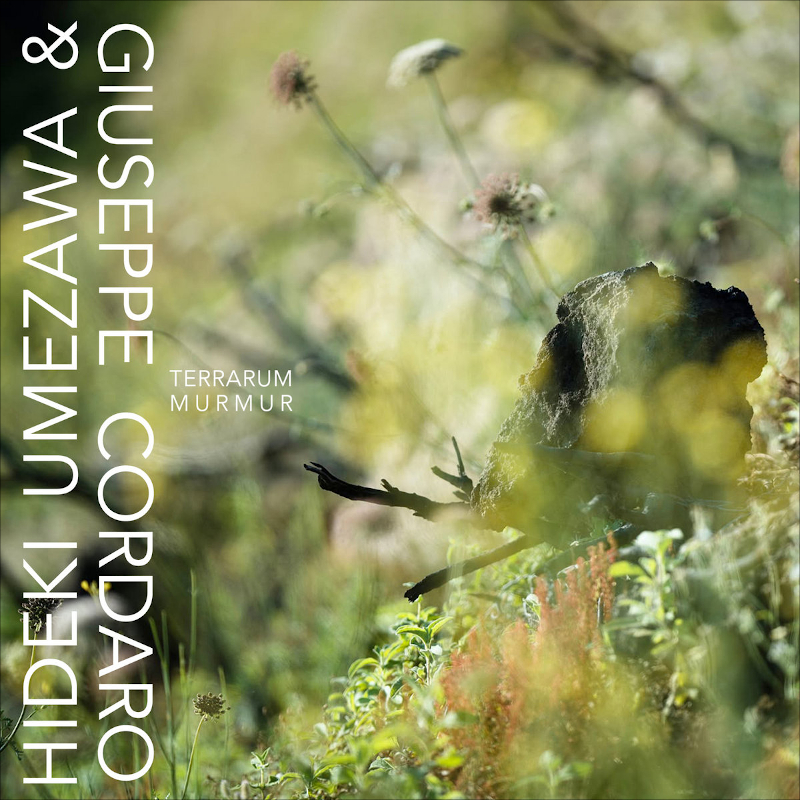
Terrarum Murmur is a collaboration between Japanese composer Hideki Umezawa and Italian electroacoustic artist Giuseppe Cordaro, born of a shared residency on the volcanic island of Stromboli in 2023. Blending field recordings, modular synthesis, and deep listening, the work captures the subtle vibrations of geological time. Far from spectacle, it invites us to hear the earth as a quiet, continuous presence—shaped by patience, precision, and a deep respect for sound as both material and method.
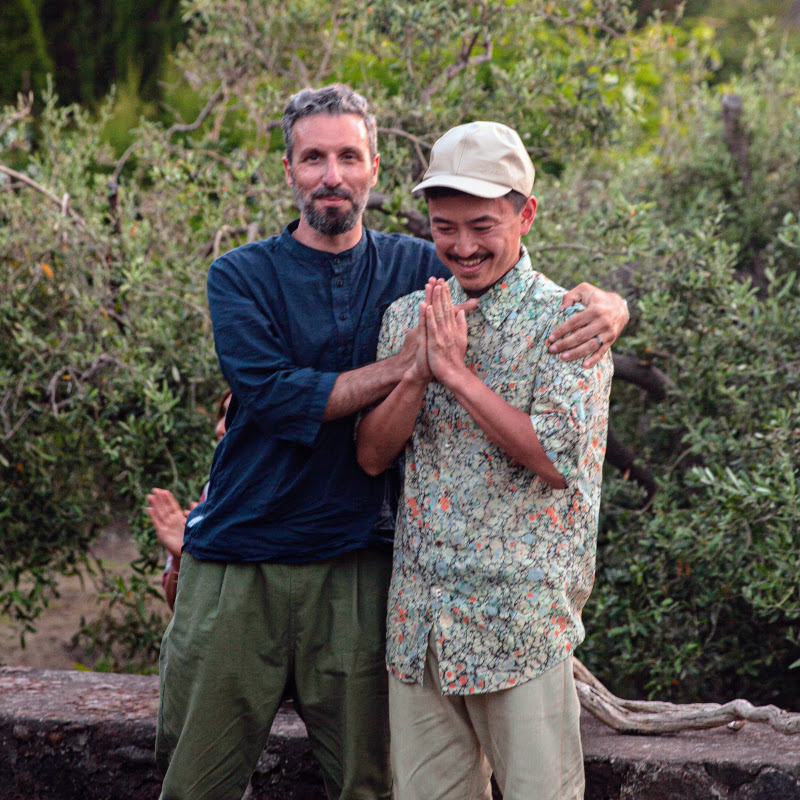
A bridge across cultures and geographies
Born in Gunma in 1986, Hideki Umezawa is one of those Japanese composers who have made the porosity between sound art, installation, and performance a method rather than merely a field of action. With an MFA in Intermedia Art from Tokyo University of the Arts, residencies at INA-GRM and EMS, and awards such as the Luc Ferrari Presque Rien Prize, his work inhabits the interval between natural and artificial environments, with steady attention to ecological listening and the materiality of sound. It is a practice that seeks the point where perception sets itself in motion, where the landscape is not a frame but an agent.
Giuseppe Cordaro, born in 1981 and hailing from Agrigento, is a prominent voice of the Italian electroacoustic school. We call it Old School not out of nostalgia, but out of discipline: the line that runs from the rigor of the Studio di Fonologia to the concrete gesture that turns the real into signal, technique at the service of the idea. Cordaro works between modular synthesis, field recording, and acoustic ecology, with projects that have interrogated Etna, the city, and the theater. It is the kind of sonic craftsmanship you recognize at once: a steady hand, a far-reaching ear, a memory for traditions and their tools.
In the summer of 2023 the two met on Stromboli, an island-crater suspended in the Tyrrhenian, where the volcano has kept time for millennia with a breath that never ceases. Supported by Marosi Festival and Liminaria/Interferenze, they listened at length to the language of the earth: murmurs, rumbles, whispers, the dusting of micro-events that precedes every visible eruption. From that patient listening came Terrarum Murmur: a joint work that probes planetary vibrations, geological time, and hidden frequencies, and that opens the path “Paroxysms Sounds and other volcanism.”
Like a geological section ::
The record proceeds in layers, like a geological section. It does not seek the picturesque of the volcano; it rejects the obvious. It opens with a weave that seems to rise from the floor: suspended micro-grains, a rustle with the density of ash, gentle low-frequency beating, then the wider breath of air that carries remote noises, barely more than audible. The on-site material is a matrix, information that modular synthesis rereads and pushes toward liminal regions, where the organic and the imaginary trade features.
The handling of time is the album’s poetic center. Durations are extended but not diluted: the form stays alert, with small dynamic torsions tracing curves of energy. There is the very concrete idea that listening can let us enter slow processes: granulation works as a lens, breaking down and reassembling, while subsonic inflections suggest the deep movements of the magmatic chamber. Umezawa stretches the surfaces, Cordaro builds the joints: a dialogue that does not settle into fixed roles and yet lets signatures surface.
In the central passages one senses an oscillation between proximity and distance: minute details: a stone rolling, a gust channeled through a fissure, a ferrous vibration, are brought into focus and then sunk back into the field, as if the landscape refused an extended close-up. Here Cordaro’s Old School makes itself heard: control of the signal-to-noise ratio, care for the attack, a classical use of equalization as sculpture. It is a continuity that looks to a concrete tradition (from Berio and Maderna onward) without mannerisms, brought into the present with contemporary tools.
The spatiality is wide but unspectacular: a deep stereo image, short reverbs thatbroaden without theatrics, headroom respected. When the “eruptions” arrive: brief bandwidth thickenings, grainy blows that open like lapilli, the mix holds and the compression remains discreet. The electronics do not attempt to imitate the volcano, they translate it beating as slowed shock waves, high harmonics with the fizz of hot dust, drones as the reminder that even stasis is movement once the time scale dilates.
To let the earth speak without raising its voice ::
The ending opts for a transparency that leaves exposed the question from which the work set out: how do we immerse ourselves in the processes that govern invisible transformations, the “deep time” that flows beneath our quick changes? Terrarum Murmur suggests that the answer, if there is one, passes through an alliance between listening and measure: record, filter, model, return. In this sense the meeting between Umezawa and Cordaro is also a bridge across cultures and geographies: distance is not an obstacle; it is the condition that makes intonation possible.
A work of great formal coherence, capable of lingering without languor and moving without showiness, Terrarum Murmur is a significant piece in a line of inquiry that looks at “extreme” territories not as scenery but as devices for thought. And it delivers, as well, the clear profile of its authors: Umezawa, who turns the ecology of listening into compositional practice; Cordaro, who naturally embodies the most rigorous Italian electroacoustic tradition, rethinking it with the calm of one who knows the instruments and their history.
Here, on the edge of a slowly burning island, the two chose the hardest path: to let the earth speak without raising its voice.
Recorded in June, 2023 at Stromboli Volcano, Sicily, Italy
Produced and mixed by Giuseppe Cordaro
Mastered by Giuseppe Ielasi
Composed and performed by Umezawa & Cordaro based on fieldwork and performance at Marosi Festival, Stromboli Island 2023.
Hideki Umezawa: electronics, field recordings, sound manipulation,
Giuseppe Cordaro: modular synthesizer, environmental sounds, ALchemy
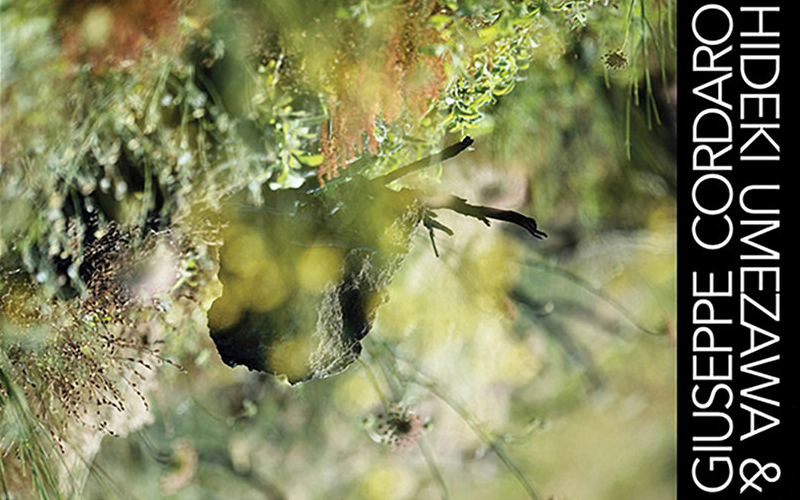
Photography by Hideki Umezawa
Design by Michael Vallera
This work was developed as part of the research project Paroxysms. Sounds and Other Volcanism, supported by Marosi Festival and Liminaria/Interferenze.
Terrarum Murmur is available on Amish Records / Required Wreckers. [Bandcamp]







![[2View] Nekomachi/no wonder • なるほど & tsubai/ilulissat (Perceptual Tapes)](https://igloomag.com/wp/wp-content/uploads/2026/10/nekomachi-no-wonder-tsubai-ilulissat-tapes_feat-75x75.jpg)