



A uniquely curated collection that embraces “experimental electronic” less as a genre than as a method of investigation—rewarding passive listening, certainly, but revealing far more through careful examination. The album invites repeated immersion into everything hiding just beneath its fractured surface.
Compression doesn’t erase information so much as redistribute it ::
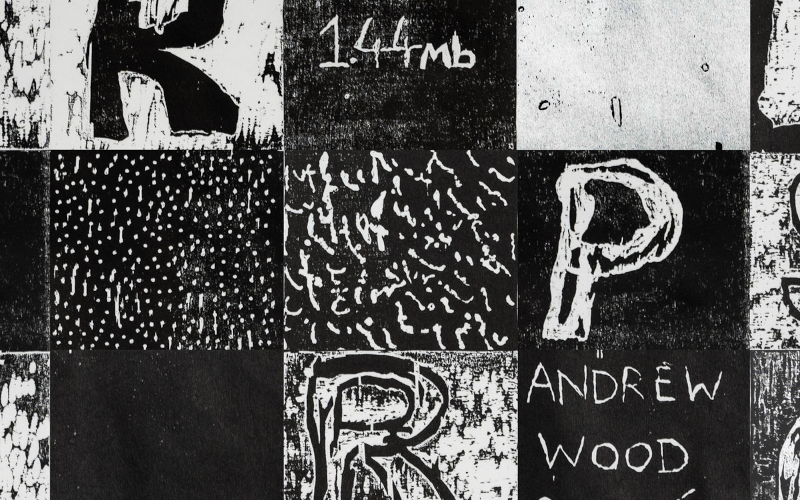
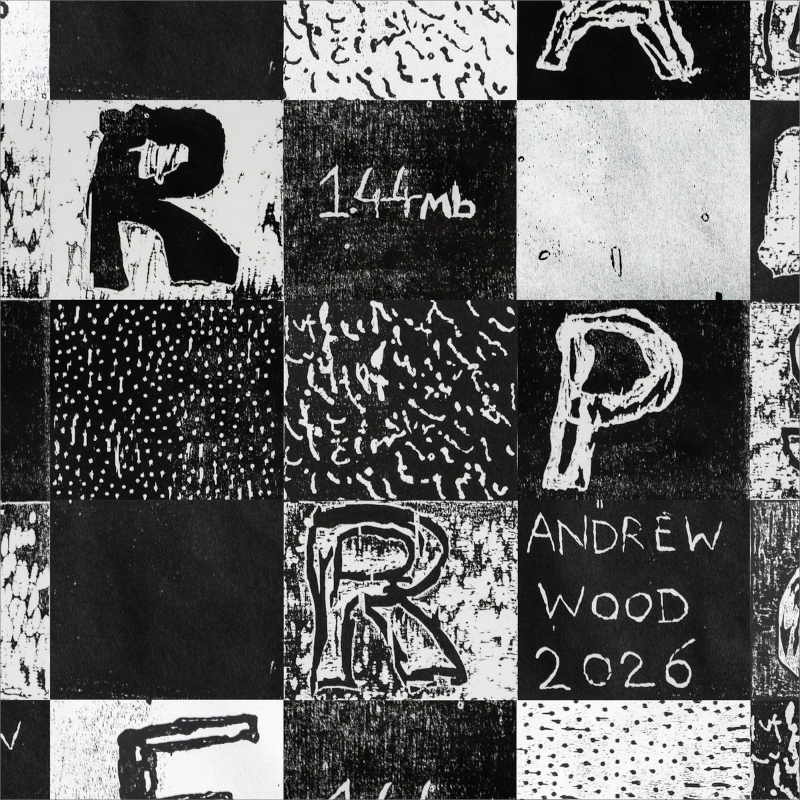
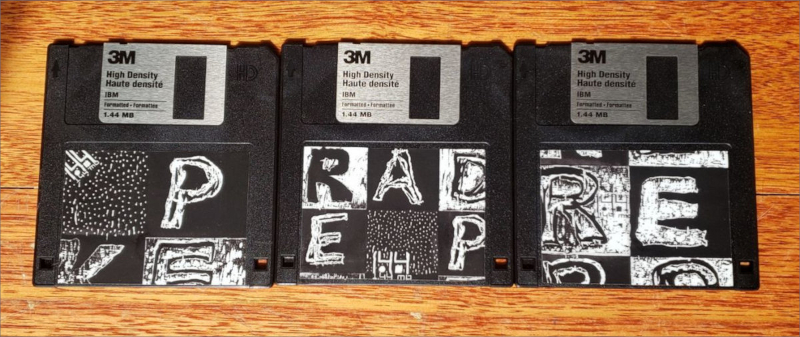
The long-lost 1.44 MB floppy disk makes a quiet comeback, sort of. The Philadelphia-based imprint notes that using floppy disks “forces audio files to be heavily compressed, creating both a challenge and tool for artists.” What many may not realize is that these disks can still be read with a modern floppy drive, functioning much like a USB device. On Andrew Wood‘s RadgePacketRemorse, that limitation becomes a compositional device, collecting 18 tracks—nine originals paired with nine compressed counterparts. Field recordings, fragmented sound samples, ambient passages, and glitch-adjacent fragments are pulled apart and reassembled into lo-fi abstractions and densely layered collages that drift far from recognizable form, yet remain oddly inviting in their disorientation.
“PiedrasBlancas,” Spanish for “white rocks,” also happens to be a stunning, rugged stretch of California’s Central Coast along Highway 1 where my wife and I have returned for more than twenty years, and where I ultimately proposed to her. Here, found sounds from that coastline—bird calls, crashing surf, and perhaps even elephant seals that gather there seasonally—are preserved with remarkable restraint. From there, Wood continually reshapes raw noise into something almost geological. Pieces like “BroodXIV,” “mWahlberg,” and “Stroad&Steeple” channel earthy resonance, peculiar blips, digital residue, and environmental recordings, allowing each element to gather, fracture, and dissolve into elusive sonic forms.
Densely layered collages that drift far from recognizable form ::
What makes RadgePacketRemorse especially compelling is hearing each original alongside its compressed counterpart. Rather than simply degrading fidelity, compression fundamentally alters each piece’s physical character. Edges soften, frequencies collapse into one another, transients blur, and once-prominent details recede into grain. “Bainbridge” illustrates this beautifully: its original version feels visceral and scratchy, recalling early V/Vm, while its compressed version becomes restrained and almost translucent, with voices retreating into a hazy distance. Elsewhere, compression doesn’t erase information so much as redistribute it, uncovering hidden relationships between sounds while replacing sharp definition with brittle artifacts and ghostly residue.
Altogether, this is a uniquely curated collection that embraces “experimental electronic” less as a genre than as a method of investigation—rewarding passive listening, certainly, but revealing far more through careful examination. The album invites repeated immersion into everything hiding just beneath its fractured surface.
RadgePacketRemorse is available on 1.44mb. [Bandcamp]
Related posts ::
 Andrew Anderson :: Thresholds (Elevator Bath)
 From A Harbour Softly Drawn & Andrew Wild :: EP (4th Ward Private Press)
 Dead Melodies :: Legends of the Wood (Cryo Chamber)
 Colin Andrew Sheffield :: Moments Lost (Sublime Retreat)
 Andrew Nolan :: Monochrome Vol. 2: Tentacles Of Spiritual Contagion (Phage Tapes)



![Andreas Tilliander :: Ljud [2026 Remaster] (Keplar)](https://igloomag.com/wp/wp-content/uploads/2026/10/andreas-tilliander-ljud-remaster-vinyl-75x75.jpg)