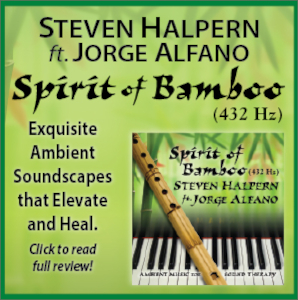


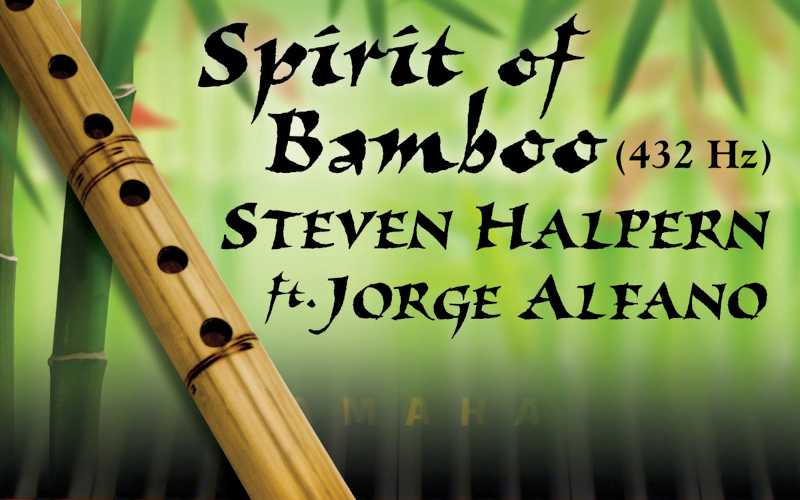



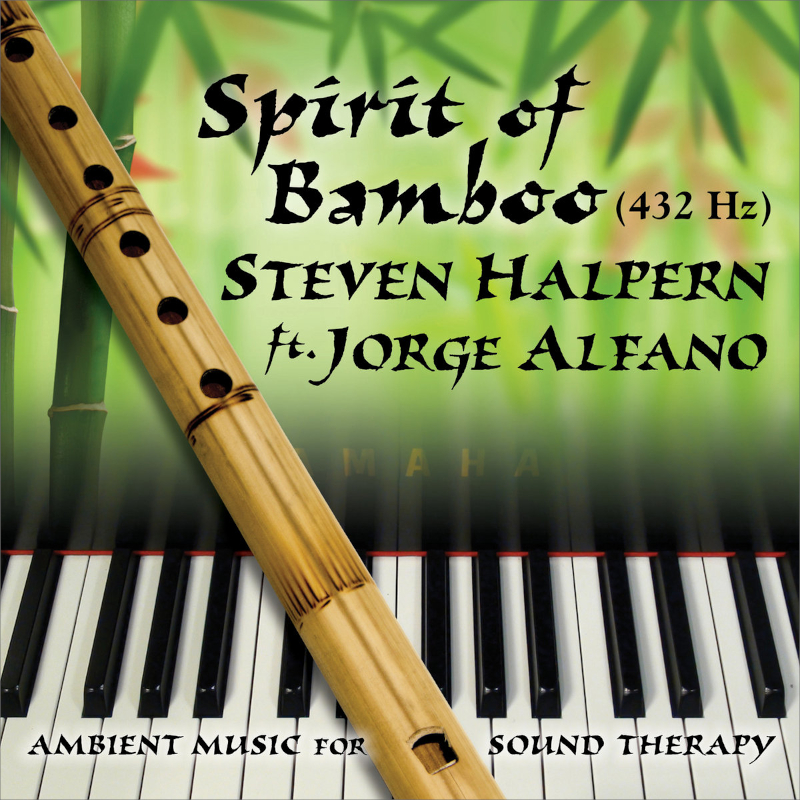
Spirit of Bamboo (432 Hz) represents a historic milestone, the first-ever duets between Steven Halpern’s legendary healing keyboards and the traditional bamboo flutes of Jorge Alfano, all tuned entirely to the metaphysically significant 432 Hz resonance.
A highly effective wellness tool for the home
In some ancient philosophies of the past, objects and beings do not take shape according to what they contain, but rather from what they lack and from what surrounds them. To learn to embrace emptiness is to become a vessel for the universal spirit. There is no physical entity that embodies this mystery more perfectly than bamboo. Revered across centuries as the cradle of humanity, bamboo symbolizes perseverance, honesty, and simplicity. It is hard-working yet optimistic, remarkably hard yet fundamentally pliable—teaching us that the one who knows when to give in and how to sway in the breeze is the one who will truly weather the storm.
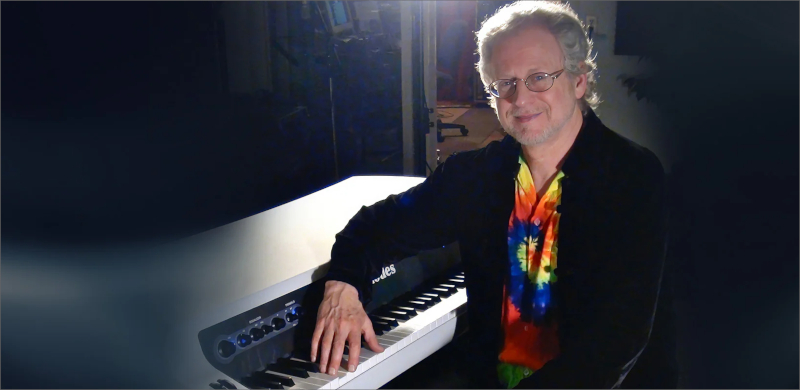
On this landmark collaboration, sound therapy pioneer Steven Halpern and Western flute master Jorge Alfano translate this ancient, resilient spirit into a profound sonic journey. Halpern utilizes his signature Fender Rhodes electric piano—an instrument that functions essentially as a series of physical tuning forks—to effortlessly entrain the listener’s brainwaves into deep alpha and theta states. The album thrives on the dialogue between Halpern’s lush, sophisticated ambient backdrops and Alfano‘s masterful command of these distinct, sacred bamboo woodwinds, Shakuhachi and Bansuri flutes.
Crafted from the dense root-end of Madake bamboo, the Shakuhachi is an end-blown flute that was used by the Komuso sect of Zen Buddhist monks not only as a musical instrument, but as a spiritual instrument for “blowing Zen” breath-awareness. The sound is earthy, raw, and highly dynamic—ranging from a fragile whisper to a piercing, metallic rasp, characterized by explosive, percussive breath attacks (murasame) and deep microtonal drops.
The Bansuri flute is a side-blown, thin-walled transverse flute from India, believed to carry the enchanting, loving voice of Lord Krishna. Its tone is sweet, fluid, and warm, allowing for seamless, vocal-like slides (meend) executed by Alfano’s bare fingertips over open holes.
The title track opens as a clean, sparse vessel of ancient wisdom. “Spirit of Bamboo (432 Hz) Pt.1” (4:52) is free of unnatural reverb, Alfano’s dry, pristine shakuhachi dances elegantly over a liquid grand piano backdrop, immediately establishing a deep inner peace. “Breath of Bamboo (432 Hz) Pt.1” (5:03) opens a slower, sustained piece where virtuosity guides the way to pure reverence. Coos, trills, and gentle ambient drones invite a soft, Celtic-tinged (to my ears) vibe into the room, creating a steady, comforting presence.
“Deep Theta v.2 (432 Hz) Pt.2” (5:00) is a ceremonial, deeply meditative track focusing on infinity and warm, guiding love. The tones are so expansive they blur the lines of geography—making you feel as though you are heading into outer space, or perhaps discovering you are already there. “Bamboo and Ivory (432 Hz) Pt.1” (5:42) brings a gorgeous exercise in contrast. Halpern’s grand piano and Alfano’s shakuhachi act as mirrors to one another, gracefully shifting between deep, grounded shadows and light, airy heights.
A smooth, dreamy walk through a dense forest ::
Evoking the opening sequence of a classic Samurai film, “Higher Octave (432 Hz) (5:36), sets a majestic stage. Centuries of tradition weep gently through slow, deep drones as the instruments intone and twirl around one another. The warriors assemble: “Samurai Sunset (432 Hz) (5:22) builds upon a rumbling piano chorus in the lowest registers that slowly climbs to the midrange, a trembling, ghostly flute paints a slow, beautifully tragic portrait of a setting sun. Next, a smooth, dreamy walk through a dense forest, “Deep Theta v.2 (432 Hz) Pt.1” (6:57). The flute speaks a soothing, ancient language that swirls and circles around the listener, easing the nervous system into effortless relaxation.
Capturing the essence of a blue sunrise, “Deep Theta v.2 (432 Hz) Pt.3” (5:03). A ringing, atmospheric morning peace is anchored by the warm, nostalgic tones of the Rhodes electric piano while the flute calls in the dawn. “Kyoto Temple (432 Hz) (5:24) presents a midnight mood featuring a smoky, late-night saxophone quality blended with celestial keys, telling a tale of deep sadness, allowing a tragic character to come into full, cathartic bloom. “Whisper on the Wind (432 Hz) (6:34) suggests a universal message of compassion that flirts with tension and release. The fluttery flute calls make the atmosphere feel slightly restless and on edge, reminding us that it is a beautiful thing to gently lean into the wind and feel its power.
The ocean beach comes alive. “Bamboo Sea and Ivory (432 Hz) Pt.2” (7:39) opens with flowing piano keys that mimic the movement of water while a soaring flute takes flight over the waves, showering the listener in peaceful tranquility and abundance. How did they get the piano to the shore? The closing track, “Breath of Bamboo (432 Hz) Pt.2” (7:25) is a dreamy, laid-back “rhapsody in bamboo” that feels like standing on a misty mountain top or a haunting Irish moor. The past calls out to you from a distant tower, wrapping the album in a blanket of timeless memory.
The significance of 432 Hz combines science and history. Before international standardization codified 440 Hz as the musical norm in 1955 to halt “pitch inflation,” musical tuning was a localized free-for-all. Giants of music history, including Giuseppe Verdi, strongly advocated for 432 Hz because its warmer, gentler tone was vastly kinder to the human voice and spirit. In modern psychoacoustics, dropping the pitch from 440 Hz to 432 Hz triggers an immediate, shift in the listener’s mood. 432 Hz is also a frequency that aligns beautifully with the natural vibrations of the Earth, the Schumann Resonance.
Spirit of Bamboo (432 Hz) is a masterful addition to Steven Halpern’s pioneering 50-year legacy of sound therapy. By pairing his clinically proven, brain-balancing keyboard arrangements with Jorge Alfano‘s breathtakingly authentic woodwinds, the album achieves a rare trifecta, a brilliant piece of Jazz-Zen world fusion, a highly effective wellness tool for the home, and a beautiful testament to a reed that has shaped human survival and spirituality for centuries. When the chaos of the modern world feels overwhelming, put on your headphones, close your eyes, and let this album remind you how to bend, sway, and beautifully survive the storm.
Spirit of Bamboo (432 Hz) is available on Inner Peace Music. [Bandcamp]