


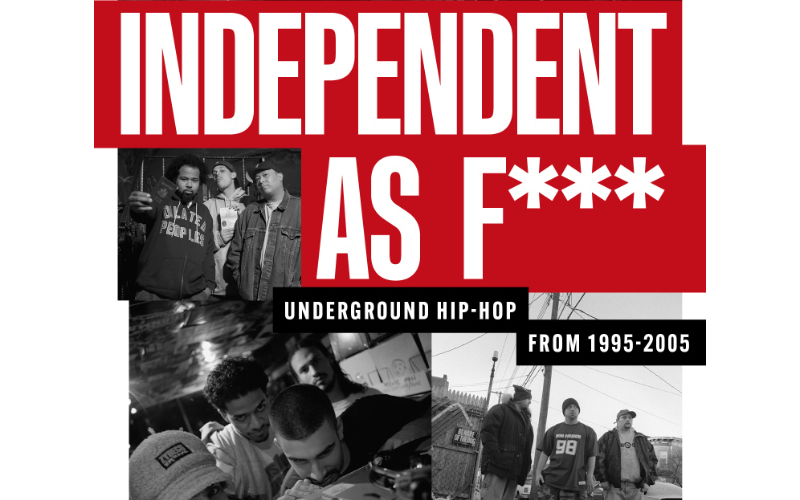


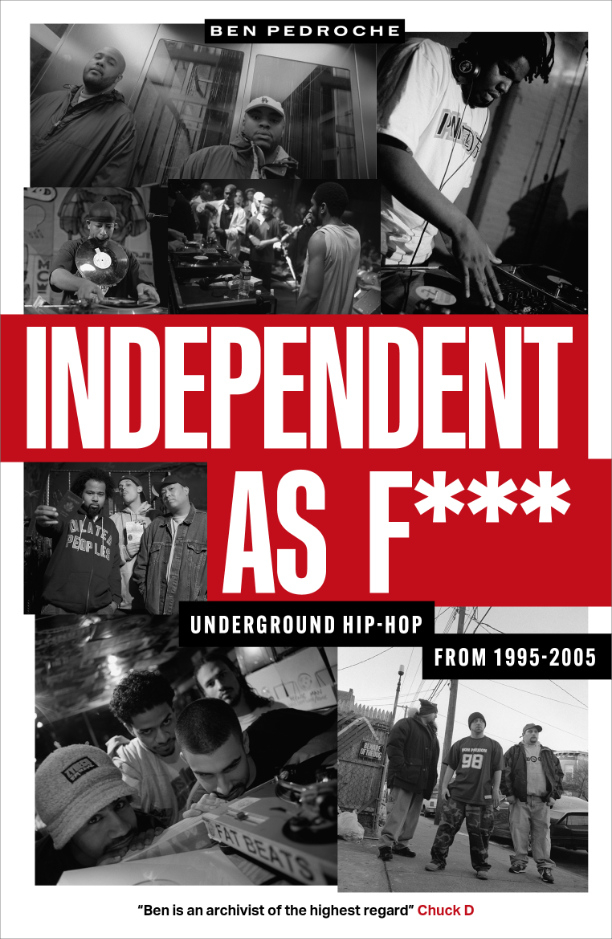
Hip-hop was never my main musical obsession, but it pulsed through the background of my youth—skate sessions, cheap forties, porch-side blunts—quietly shaping the soundtrack of growing up. Ben Pedroche’s Independent as F*** a vibrant history of indie rap from 1995–2005, taps straight into that world, revealing how artists built their own freedom and infrastructure far from the grip of major labels.
The hidden story of indie Hip-Hop
Hip-hop has only been a small part of my musical diet. But it’s always been there in the background, part of the soundtrack to my misspent youth skateboarding around the city. It played during the underage drinking sessions of malt liquor forties and while we passed blunts in the park or on a porch. In adulthood my listening to the genre faded quite a bit, because most of my listening was based on the records my friends had in their collections, while I was busy buying up ambient, industrial, and punk, going down into other rabbit holes of collecting. Yet I’ve always been fascinated by a variety of styles of music, and even more so, by the subcultures around them. Whether it was the Beatniks, hippies, punkers or the industrial scene I have immersed myself in reading about, or later the danceable energy around the rave movement and moment, or the technological quests of the hacker community, if there was a subculture built around something, I’ve been interested in that subculture. In the last few years that’s manifested as reading more about graffiti and hip-hop. Independent as F*** by Ben Pedroche that came out earlier this year fits perfectly into all of this, and even covers the years when my youth was most misspent.
One of my favorite musical histories of all is Our Band Could Be Your Life by Michael Azerrad. What I love about that one is how much it can act as a blue print for how to set up alternative networks in the underground. That book focused on punk, but the principles behind how the bands created their own labels, how independent labels supported independent bands, and the DIY infrastructure of zines and venues that allowed for the spread of the culture remains of vital importance. Pedroche’s book fills a critical gap in the history of independent music and does so for the vibrant scene around indie rap. The stories he tells are a kind of essential information for any creator who wishes to work independently from corporate labels and publishers.
Pedroche gives an excellent definition of what it means to be independent. “Being independent means that the artist or ‘indie’ label they are signed to is responsible for creating, manufacturing, promoting and selling their art outside of, and with no assistance from, the systems, processes and marketing channels of a major corporation. An independent film is a movie not made by a studio. An independent book publisher, like the one publishing the book you are reading right now, does so without the support and infrastructure of a large publishing house. And an independent musician is one who writes, records, presses and sells their music themselves, with no help from a record label. An independent musician can be signed to an independent record label, like many of the artists talked about in this book, but that record label is also still operating outside of the major label system.”
Indie Rap’s untold revolution begins ::
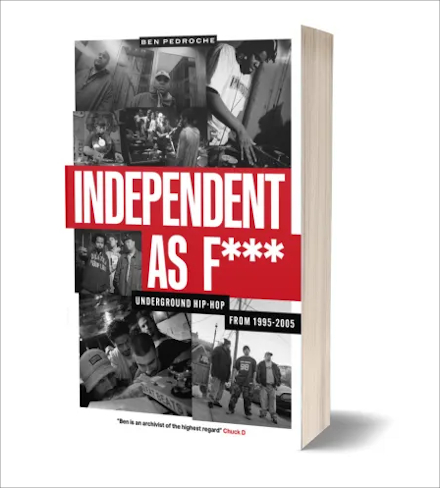
I should note here for full disclosure that Pedroche’s publisher is the same as the publisher of my own book, Velocity Press. Velocity is a fully independent publisher whose model operates very closely to those of independent record labels. The creeping crawl of conformity is best resisted by voices who can’t be pushed around because they are beholden to a bottom line on a corporate ledger. All of this stuff applies equally to the many independent electronic music labels operating in the current ecosystem. Another book out from Velocity, the second edition of Nick Sadler’s The Label Machine, gets into the business side of things, and shows how creatives can make a life doing this kind of thing, without compromising their beliefs and vision.
Pedroche adeptly points out how dangerous hip-hop was and is here in the US, where the moral panics led by conservative voices have frequently lambasted the subject matter of rap lyrics, all under a veneer of thinly-disguised (when-disguised-at-all) racism. I still remember when the Body Count album from Ice-T’s heavy metal band was pulled from the shelves, but circulated in bootleg copies and tapes. I still remember sneaking to listen to 2 Live Crew with the volume turned down so our parents wouldn’t hear. The Satanic Panic of the 80s wasn’t far behind us then, but now these rappers, with their sex and their violence, were going to be the new wreckers of civilization. At least according to neocons, Christian nationalists, and the likes of Tipper Gore. When the corps would pull this stuff, it left free speech loving musicians in fear, and many of them went into the underground. There the artists found and forged their own freedom by going DIY and indie. In turn their own aesthetics and ethos found room to grow and flourish amidst a sympathetic audience, equally turned off by corporate America and all the voices it left out.
Pedroche’s first chapter shows how the MCs, beatmakers and DJs of the early nineties worked together in their crews to lay the groundwork for the explosion of independent minded hip-hop that followed. All of the stuff that had been bubbling up from the first emergence of rap, DJing, breakdancing and graffiti since the 1970s, and was now being concocted into new brews by the artist and fans who’d been lapping this stuff up from the trough. His book focuses on the time frame between 1995 and 2005, but he starts by showing what had first emerged in the years leading up to his starting point.
One of the strengths of this book is its focus on regional scenes. This endeared me to the text, in the same way as the regionalism that was on full display in Azerrad’s Our Band Could Be Your Life. Pedroche shows how the experiences across the US shaped the flavors of hip-hop coming out across the diverse land. There is way more going on than just east coast versus west coast, or the dirty south, though he does give a chapter each to the independent hip hop that came out of New York and California, before diving into what was happening around the rest of the United States and parts of Canada.
He then gives due credit to the labels who put out the music on CD and vinyl for fans to buy and for scenes to develop around. This gives readers an idea of what to hunt for when checking out the used racks at their local record shops and vinyl emporiums. Another chapter gives a chronological and alphabetical breakdown of the important indie releases to come out between 1995 and 2005. For those just investigating the genre, these are the waystones that will guide them along the path. Electronic and experimental music fans should really open up their ears to this material, as much of it is quite out there, and they routinely make use of similar gear: drum machines, samplers, synthesizers and more.
His book ends with some thoughts on where hip hop has been in the twenty years since 2005, and where it might go in the future. It’s a future that looks as golden as its past.
Independent As F***: Underground Hip-Hop From 1995-2005 is available on Velocity Press.



![[2View] Nekomachi/no wonder • なるほど & tsubai/ilulissat (Perceptual Tapes)](https://igloomag.com/wp/wp-content/uploads/2026/10/nekomachi-no-wonder-tsubai-ilulissat-tapes_feat-75x75.jpg)