


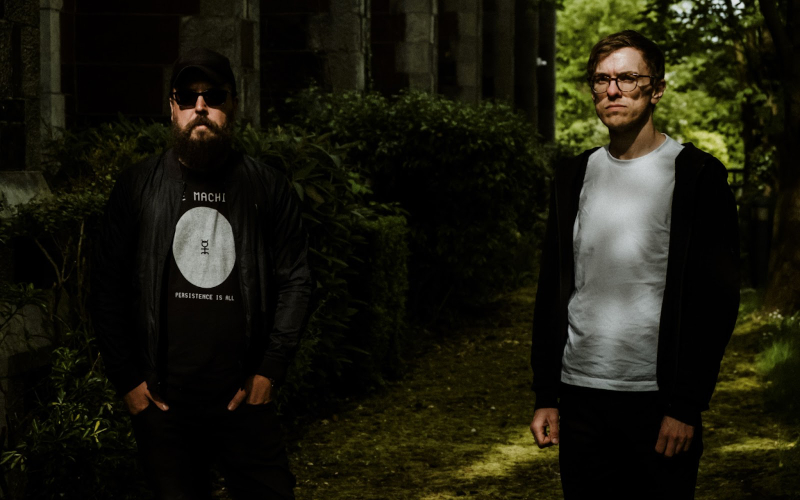


In experimental sound, collaboration often stems not from strategy but from shared sensibility. Such is the case with Stone and Worship, the compelling new duo release from Phil Maguire and Primož Bončina. Coming from gestural heavy guitar and electronic bass drone music respectively, the two bonded over a deep reverence for minimalism, physical space, and the ineffable power of sound. Their partnership is built as much on intuitive listening as on careful deliberation—a quiet resonance that became a mutual language, shaping Stone and Worship into a work of subtle force, where each frequency, pause, and vibration speaks volumes.
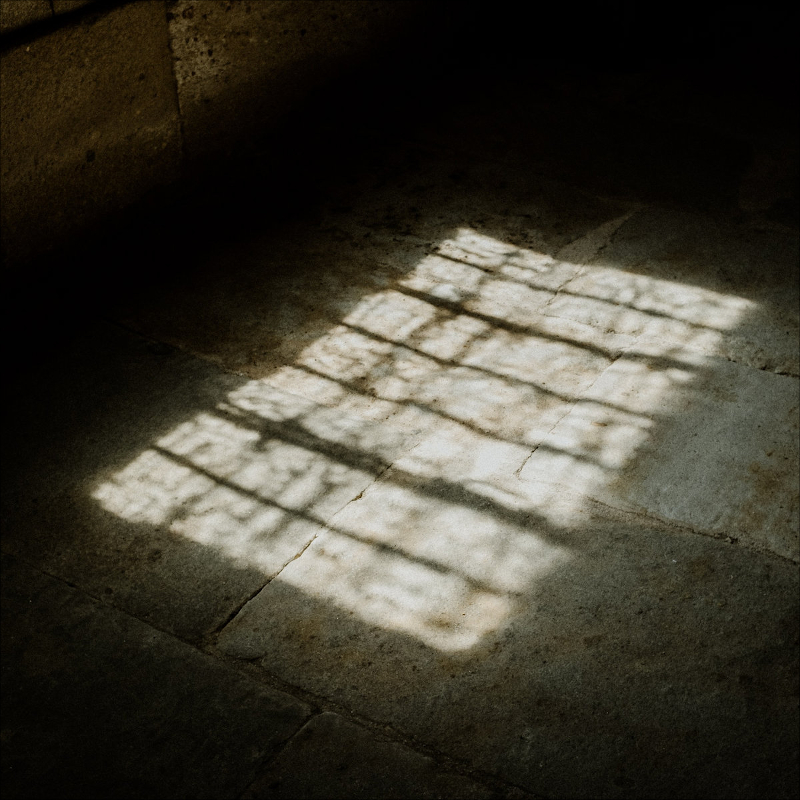
“It’s more about the space. Open or internal.“
top: Album artwork for Stone and Worship [photo credit: Primož Bončina]. Top: Promotional photo for Stone and Worship (L-R) Primož Bončina, Phil Maguire. Cork, 2023. [photo credit: Sanja Rejc].
When asked how their collaboration began, Phil Maguire and Primož Bončina both admit they’re a bit fuzzy on the specifics—but what’s clear is how naturally their creative paths aligned. Maguire first discovered Bončina’s work through his Cloudchamber and Altars projects, while Bončina recalls hearing Maguire’s sparse, evocative electronics via the now-defunct label Soft Error. During the long hours of lockdown and low activity, they struck up a conversation that eventually brought Maguire to Ljubljana in 2022 for a duo performance at a computer museum—an improvisation that would plant the seed for Stone and Worship (Cloudchamber, March 2025). “We just started recording,” says Bončina. “No fuss. We trusted each other’s instincts.”
Dave Aftandilian / Igloo :: How did the two of you end up collaborating, and what specifically about each other’s approaches to music drew you to each other?
Phil Maguire :: I can’t remember which one of us found the other, but I first became aware of Primož pretty much through Cloudchamber and his Altars projects (altars / spires). That was maybe three or four years ago.
Primož Bončina :: Yeah, Phil, you were doing a lot of releases around that time, right?
Phil :: I was working as a university technician. There wasn’t much work to do from home during the Covid lockdowns in the UK, so I had plenty of time to work on these longer-form releases that I’d always wanted to do. We got to know each other that way, and then I came over to Ljubljana to play in June 2022. That would have been the first time we met in person. We talked a lot about playing together as a duo because we had a lot of common interests, and we recorded an improvisation there.
Primož :: Yeah, we did that computer museum thingy as part of “Spectral Chimeras I.” It was a day after the show, we did two duos – Phil and myself and Karen of Golem Mécanique (GM Bandcamp and Titania Tapes) and her partner Thomas Bel (thomas bel BC and Distant Voices). Karen and Thomas did the first run of her Luciferis album in a live performance (LUCIFERIS).
It was like a test run. That museum building is a pretty cool place. It’s this glass and concrete modernist pavilion-like building from the 1960s; the concrete wall is definitely a feature in that place. The combination of glass and concrete in that building gave the performance a secluded yet open character. It was a really cool experience. It felt like creating a small timewarp in this place between apartment buildings and a busy road. Part of the recording is on YouTube as well: SPECTRAL CHIMERAS I.
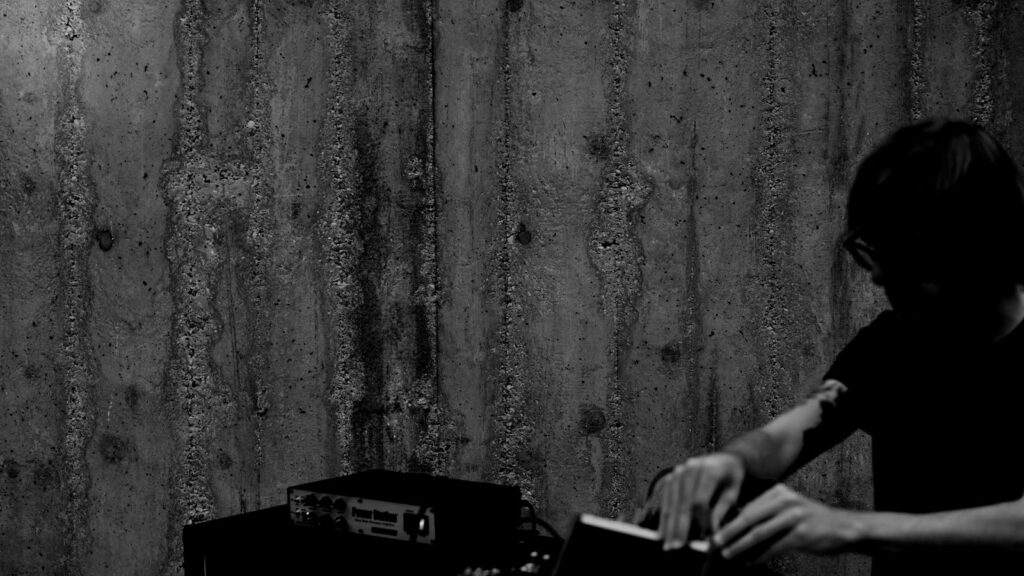
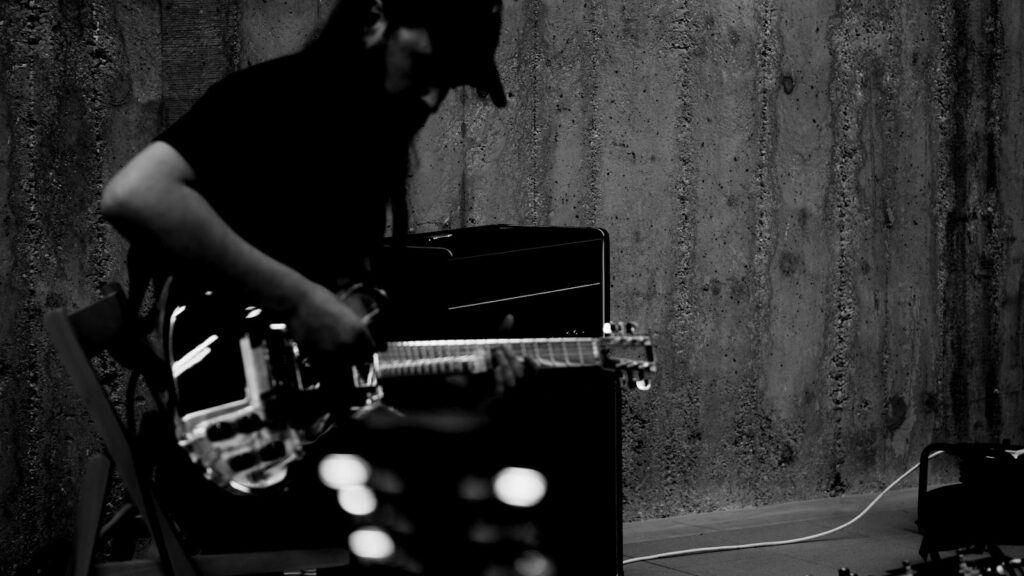
above, left: Spectral Chimeras I / Phil Maguire. Ljubljana, 2022 [still from video: Laszlo Juhasz].Above, right: Spectral Chimeras I / Primož Bončina. Ljubljana, 2022 [still from video: Laszlo Juhasz].
Just a handful of people. Can’t really get a big crowd in the room for this kind of stuff locally. This was in 2022. We’ve had that live recording for a while and were re-listening and debating it a lot together. It seemed to have musical potential worth exploring further at that point.
The first time I heard Phil‘s music was on Mark Lykens’s (now defunct) sound art tape label called Soft Error (SE bandcamp). He’s a filmmaker from Scotland whom I got in touch with via some of my friends in Berlin, and also does music and noise projects under the monikers Rural Noise and Janza Slope. Soft Error released stuff like Phil’s “brak,” Jos Smolders, Chemiefaserwerk, and Giovanni Lami. A bunch of cool stuff. Labels like his are such a great way to get informed about people that are doing interesting things in kind of more of an underground setting, I suppose.
Dave Aftandilian :: Well, I’ve certainly found a lot of great artists through Primož’s Cloudchamber label (+CC+ bandcamp). So thank you for that!
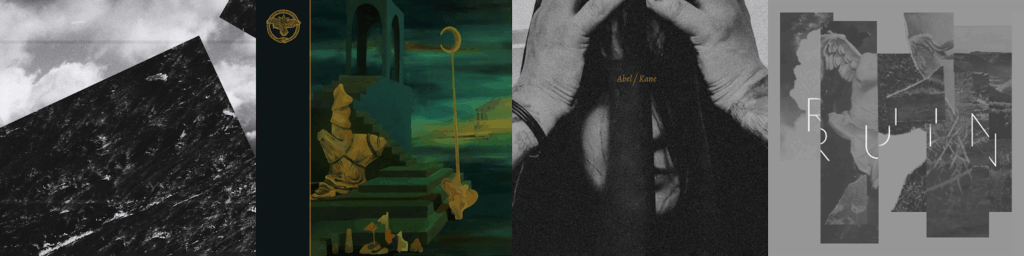
above: Cloudchamber Recordings releases, left to right: Phil Maguire – Zeeschuim, Je est un Autre – Flatworm Mysticism, Golem Mecanique – Abel/Kane, Prms – Ruin.
Primož :: Thank you, much appreciated! Cloudchamber started off as a platform for works by me and my friends, and the circle kept expanding into what it is at present—not necessarily adhering to many set rules but trying to keep an underlying aesthetic and/or deliberation to the editions, though not strictly bound to a specific type of music. It’s very rewarding to meet like-minded individuals and document some brilliant musical worlds they create.
Dave :: Could we also mention Phil was doing his own label, verz? Phil, what was the main motivator when you started verz?
Phil :: verz was a label, a radio show on ResonanceEXTRA, and a concert series that I ran from 2016 to 2022. I held the concerts primarily at Hundred Years Gallery, which is a wonderful art space and one of the very few remaining experimental music venues in London. Other concerts took place in Newcastle, Huddersfield, Amsterdam, and Eindhoven.
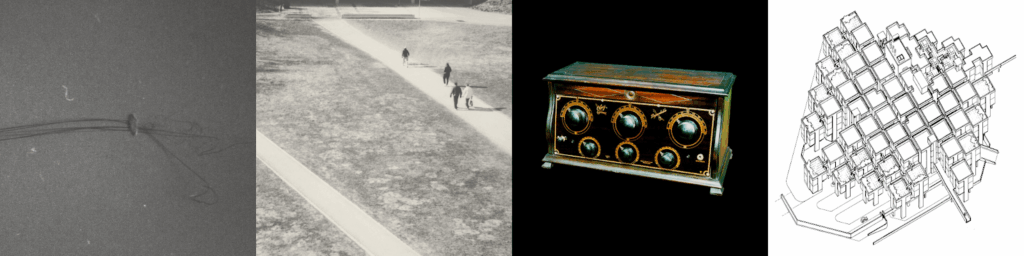
above: verz releases, left to right: David Donohoe & David Lacey – Obsequio, Phil Maguire – Ijzer en staal, Tim Olive – Okay Grand Dependable, Matthijs Kouw & Phil Maguire – Isometry.
The motivation for verz was that I’m really into what I used to call “quiet music”: anything from field recordings to early 2000s Japanese electronic improvised music. The really sparse, ultra-restrained stuff. It was an excuse to find and listen to more music; to be more proactive and connect with artists from outside of London. During its time I put out close to 30 releases and held several concerts per year. I closed it in the summer of 2022 because I was having some health problems. I also knew I was going to be leaving the UK at the start of 2023 and I felt that I had done everything I wanted with it.

Dave :: Beyond the realm of sound and music, what inspires you guys? Are there any kinds of media or specific works that maybe had an impact on this album that we’re talking about, Stone and Worship, or just your music in general? What influences you?
Phil :: I often take more influence from visual arts like painting and sculpture. I think about Agnes Martin a lot. She was an American painter active from the 1950s until her death in 2004, and she painted these large, mostly geometric pieces. They’re grids and lines that are very regular-looking at a glance, but then when you get close to them, they’re full of imperfection, detail, and texture. They’re almost three-dimensional, and most of them are six feet across so if you get close to them, you feel like you’re enveloped in them.
There was one painting of hers, Morning (1965), that was in the Tate Modern for a while (see tate.org). It was right at the start of one of the permanent displays in the first room and I would go there just to see this one painting. It’s a light gray field with a grid drawn in pencil. Another grid is drawn around that in a faint red (I named my recent solo CD faint red / pencil lines after this; faint red/pencil lines). I can get lost in it so I often think about that kind of experience of space and material as an approach to sound, more than other forms of music. I have training as a musician, but Western theory never really clicked for me. Things like abstract expressionism made a lot more sense as something I could relate to my own practice.

above: Morning (1965) by Agnes Martin; copyright Estate of Agnes Martin / DACS, 2025
Dave :: How about you, Primož?
Primož :: I would say definitely cinema–the medium to slow, long ambient stuff, the quiet stuff, cinema that explores the moment. I’ve recently enjoyed delving into the Chinese director Jia Zhangke’s filmography and the retrospective works of Stan Brakhage. Also photography as a biosphere snapshot. Stuff that explores presence. Travel and solitary experience of the world as a meditative practice.
Other than that, plenty of woodland wandering, I spent the last four or five years living back in Slovenia and I’ve just mostly been in the forest more or less regularly. Growing up I spent a lot of time in nature as well, in a tiny town in the middle of the forest. So it’s always been a huge influence in a way. It doesn’t necessarily make any musical sense. It’s hard to say—I believe it’s more about the space. Open or internal.
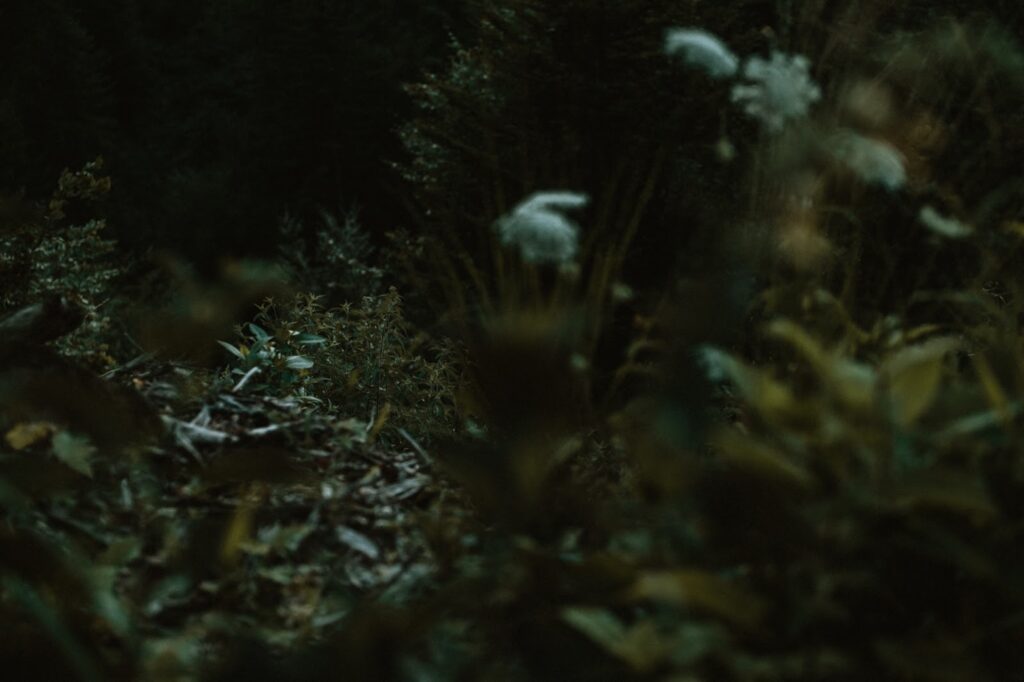
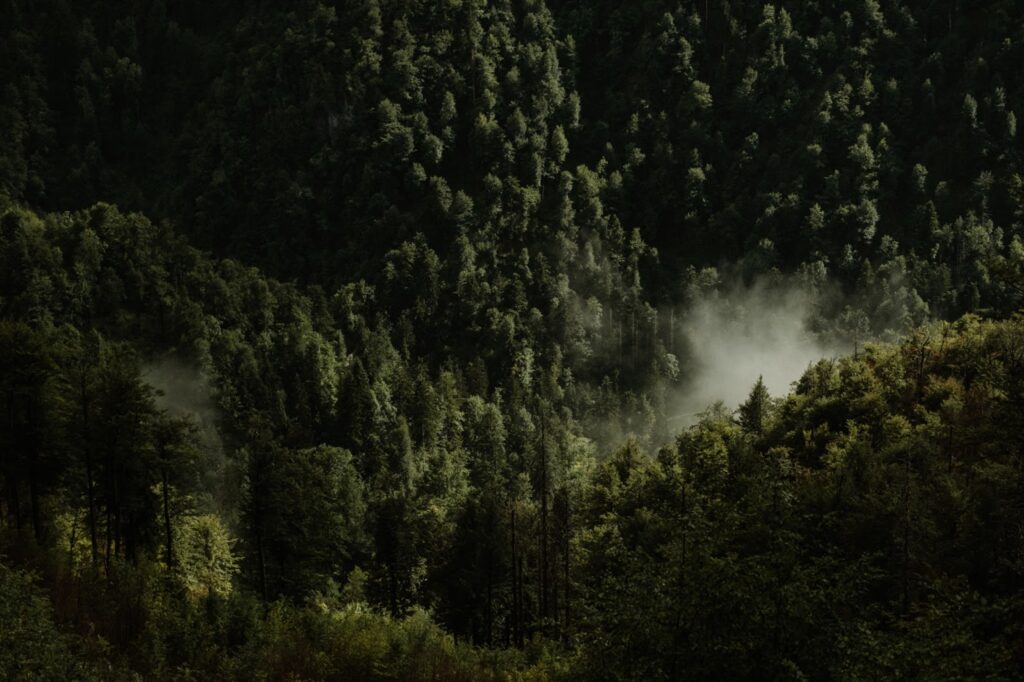
above: Series in green. Forest plateau, Slovenia, 2019-2023 [photos by Primož Bončina]
More of trying to create spaces. Trying to envision some spaces, or put the landscape into sound. I’m fascinated by the promise of the horizon; it’s like a limitless dream. I do a lot of landscape ambiance photography, some of which may end up on Cloudchamber as album artworks of some sort. For some reason usually there’s not a lot of human motives for me; I think there’s more than enough of that in this day and age.
Dave :: I think that’s part of why you and I clicked, Primož. Nature for me is where I feel most at home. And just when I’m walking along…we have a river here and there are trails along the river (trinity trails), and that’s sort of my meditative space outdoors. And I always challenge myself to write poetry, you know, not great art, but to sort of explore how I’m feeling in that moment and remember new things that I see. Like on a recent walk I was listening to birds and imitating them, trying to make their calls back, which I’m bad at. But I was trying, and I had this image in my mind of my mouth turning into a beak and my arms into wings, because when we try to speak another’s language, that’s how we can connect with them for me.
When you’re working on your own, what are your compositional and performative practices like? And then how did you adapt them and change them when you were working together?
Primož :: There’s a lot of different angles; it depends on what I’m working with. If I’m working from a performance it’s mostly improvised. I would say in the initial stage it all begins with improvisation. Specifically with the electric guitar I was developing this more stripped-back, improvised but minimalist approach with a choreography project I was involved with called Density Yoga, and it evolved from that practice, trying to block out rough parts, finding interesting harmonic overlays. If I’m working on something in a longer form, I’m trying to set rough parts, within which some conditions are set, but it’s all still down to intuitive navigating after that.
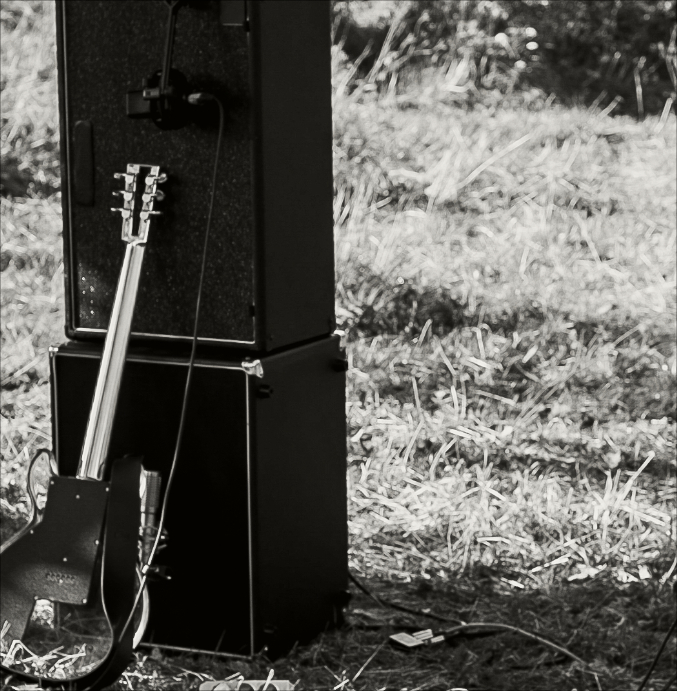
above: Still from YOGA XIV, 2024 [still from video by Sanja Rejc] YOGA XIV
Having worked with synthesizers, computers, and other electronics for some time under the alias Prms and others, I circled my focus back to electric guitar. I was kind of drawn to it; perhaps it has to do with growing up with playing, you know, metal and stuff. There was a period for me of looking back and reevaluating some things and this was a result of that. Stripping back what I learned over the years and trying to develop a gestural language. It’s expressive in a physical way, since playing an instrument is more connected to the physical body for me. And the responses are conditioned on observation and reaction. This is all a distilled version of a personal approach to improvisation, observing and deciding to have or abandon control, and what to communicate. An attempt to transcend is always present, but there is no greater knowledge, just the moment’s gravitas.
All this performative aspect is connecting to the material that is being recorded and the second part is usually listening back and that’s the part that takes quite a long time to truly understand the material, at least for me personally. How this material is placed, on which sections does it speak, what are the strongest points, and how to contextualize it. It can take a long time to detach yourself from the work and try to see it as what it is outside of yourself. Sometimes it’s best to forget the material exists and approach it as a fresh piece of music to your ears.
Without forcing it too much and letting it breathe, but that’s more of a question of editing afterwards. Intuitive performance and curation, that’s a big part of the compositional approach for me I would say. And also a lot to do with listening and seeking to define either a narrative or the center of the material, let’s say a good focal sound point, kind of a golden center, you know? Something that gels nicely – the sweet spot.
I am always impressed at how even recorded material constantly warps when you listen back to it through different prisms and states of mind. Your perception of it is in perpetual flux.
Developing a gestural language ::
Dave :: Phil, how about you? How do you normally work?
Phil :: Up until a few years ago I would make simple outlines for the structure or form of a piece; a sequence of “1, 2, 3, 4, 5,” say. But in practice, especially in a live situation, that never really worked for me. I would get too distracted thinking about the next thing in the outline and I wasn’t thinking about or listening to what was happening in the moment. I abandoned that way of working during the pandemic, when I had time to really sit with the sound and let it run for an hour or more if I wanted to. Letting that go was a really liberating thing.
Now, when I’m composing something, it comes from a lot of very slow motion improvisation. I’ll patch something up on the synth or in Max/MSP and listen for a while, not touch anything, and then make a very small adjustment. Then listen for a while, make another adjustment, and so on. It can be quite a long process of finding the initial sound.
Over the last few years I’ve been working at making music that doesn’t have a pace, or doesn’t feel like it follows a linear time. It’s kind of impossible, but the challenge of trying to do that invites me to listen much more closely and be much more attentive to what’s happening. I can appreciate the sound in the moment. There’s a long editing process as well where I take a lot of things away from a piece as I’m making it. I very rarely add anything at this stage; I take away and take away and take away. My solo work at the moment is almost not there. I’m currently working on a piece that’s composed solely of low-volume sub-bass tones, for example.
I see this as similar to Primož’s approach. Maybe we come at it from different angles, but I try to find some kind of core thing in the sound that everything else can explode out from. Sometimes I think of it as a ball inside of a larger sphere, and that’s the area within which the sound can move.
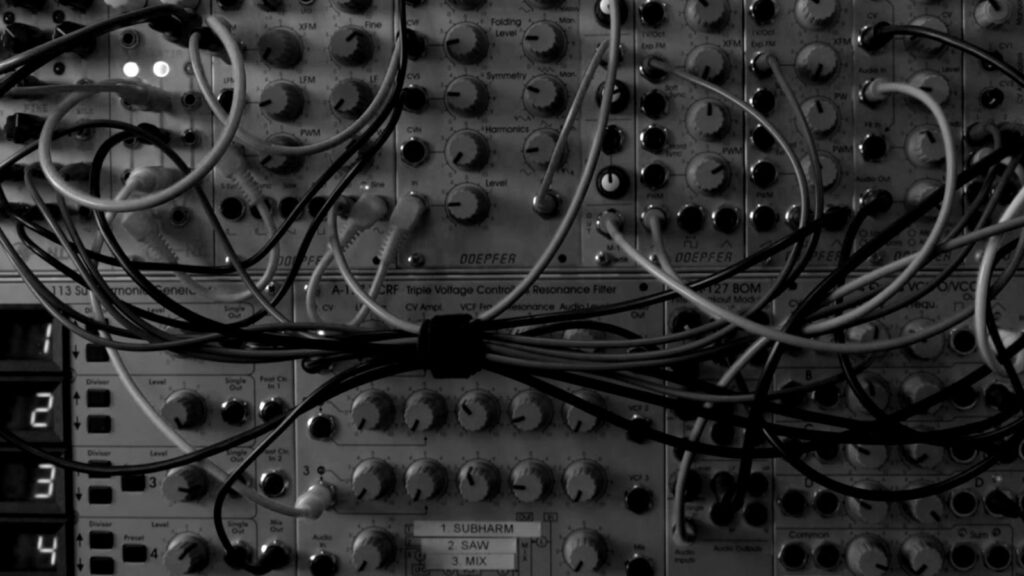
above: Three Oscillators, 2023 [photo by Phil Maguire]
I work in free improvisation as well, playing solos and in groups. It’s much more volatile and gestural than my composition work. Sound gets thrown all over the place, but I think there is a connection. In both of these areas of my practice, the sound is going into the physical space and it’s about experiencing how it interacts with that space and the other sounds and bodies within it. The experience of the sound is the experience. We’re in space and we’re experiencing the sound together. That’s the essence of how and why I’m making work with sound.
Frequency as a physical color ::
Dave :: For this album did you guys send each other an idea or a couple minutes of music, or how did you start the composition process? You’ve got these four very long pieces on the album—“Dolorosa,” “(Vangelis) Acolyte,” “Movements in Dust,” and “Megalithic Fountain”—and I was wondering how you created them together.
Primož :: We just started recording. I think we share this zero fuss approach, not letting over-intellectualizing get in the way of the raw recording process. It’s quite pragmatic in a way, like we know what we’re doing and we trust our instinct.
I guess we understand each other’s work, even when we’re seemingly working in different spaces. What I’m doing or what Phil‘s doing could be independent of each other but it is also complementary, if that makes sense.
It creates heaps of space for either of us to work within that. But yes, we just started recording. We recorded for two days. I think two sessions, or was it three?
Phil :: I think it was two days in the end. We had a setup evening beforehand.
Primož came to Cork two years ago and we recorded in the studio of the music faculty at the university where I was working. We’d had conversations since we did the recording in the computer museum in 2022 about how it might work. I listened to that recording a lot and would go away and think about it, and we’d have conversations about how we could structure some pieces. We worked out some simple frameworks.
We wrote a few down but didn’t use them in the end. We just started recording.
Primož :: What we agreed on was like, okay, this part we set to this fundamental frequency.
Phil :: Yeah.
Primož :: Which is also listed in the album’s liner notes, which root each piece is on, and then we were just working around that. It does change the overall frequency response of the room; it changes a lot of things just shifting it to another fundamental. And working within each particular one–a different physical color, if you will.
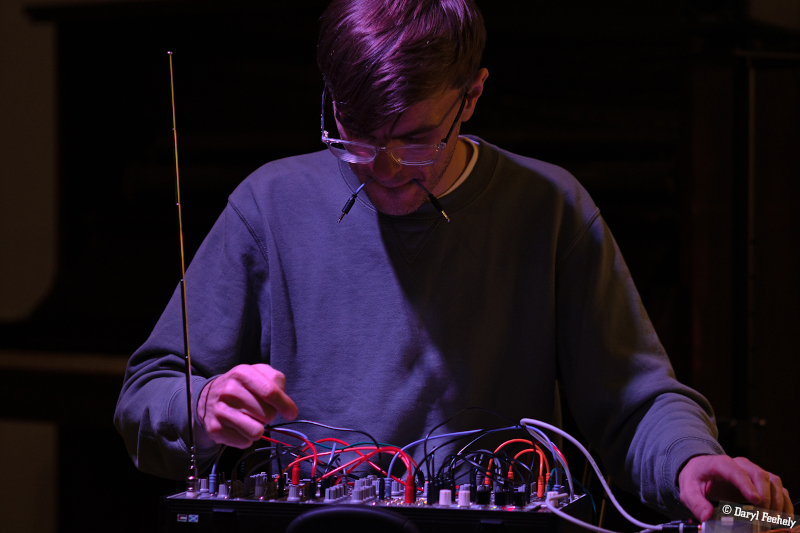
above: Phil Maguire live, 2023 [Photo by Daryl Feehely]
Working with resonance in space ::
Dave:: Can we dig into that a little more? How do you pick the specific frequency or timbre or resonance that you use for a particular piece?
Phil :: I think it can just be a resonance in the room that can be the basis of a piece. Maybe we hit a particular frequency that makes something in the room vibrate in an interesting way, or maybe there’s a sense that it fills the space in a certain way. Perhaps we’re close to a room tone in those moments.
Primož :: Yeah, that’s a good point, Phil! I play in a certain tuning for a certain guitar. I mean guitars are all subtly or not so subtly different from each other in a way where the necks resonate. They all have their sweet spots, or several sweet spots. So I’m mainly working around that one which feels like it’s resonating in an interesting manner. How to describe it as more like…it sounds fuller from the instrument’s perspective, like the material it is built from would be better aligned to a particular oscillation.
For these sessions I used one of my aluminium-necked guitars–those are a perfect fit for extended and even resonances–you could say the frequency response is flatter and the dynamic range larger. I can’t get enough of them since I discovered them via witnessing players such as Osborne, O’Malley, Turner and of course Albini. They are very popular in the doom, stoner, indie scenes for that particular characteristic but sound amazingly clean as well. The harmonics are strong and the natural chorus gives it an almost piano-like feel when strummed. I’ve used the clean tone on my duo release with Bruno Duplant, Un été sans fin (see link)–those low end harmonics intertwine so beautifully!
Phil :: Yeah, I think the cyclical part of it is interesting as well.
Primož :: It’s to do with the instrument as well as, as Phil was mentioning, the room…different rooms have different responses and you don’t know until you try a particular room to see where the room works. So it’s really space-dependent as well. There is something truly special in playing the space. So many different spaces. Not all of them great, of course!
Dave :: You mentioned narrative earlier. And on Stone and Worship there’s not a whole lot of voice, but I still feel like it’s storytelling. I tell my students storytelling is maybe the oldest art that humans have, because if you look at the cave paintings from thirty thousand years ago in western Europe, those spaces had particular resonances, and it seems the places where Paleolithic peoples chose to put their paintings were chosen in part for their resonant qualities. Probably they were also telling stories in these spaces where they painted the walls, and likely playing music—certainly archaeologists have found flutes from that era and they’ve played replicas of them in these cave spaces and they have a very interesting sound, almost birdlike, almost like you’re setting a spirit free in the cave. (You can hear what I mean on this performance with a replica Paleolithic flute played in the Hohle Fels cave in Germany):
Do you feel there is room for narrative storytelling in what you describe as cyclical, minimalist, drone music, or is the music more about creating a space that the listener then fills with their own stories?
Primož :: I’m gonna go first, if that’s okay Phil. (laughs) Phil‘s music from my perspective is very… time-wise, you get a bit confused after you’re encapsulated in it for long enough, you kind of lose temporal anchors with his music, if you allow yourself enough time for the experience to kick in. It feels like you’re standing still and moving at the same time. Like the whirling Dervishes, engaged in Sema. Only you are preferably sitting down!
So, it has to do with motion, things need to be engaged in a stream. It’s a cyclical undulating motion, going outwards. I kind of have to take the blame for trying to impose a little narrative on top of these motions. They are the foundation on which everything is built. That’s how the material kind of developed. So we’re just…kind of letting it be as it is, like following on a drone so it’s continuous.
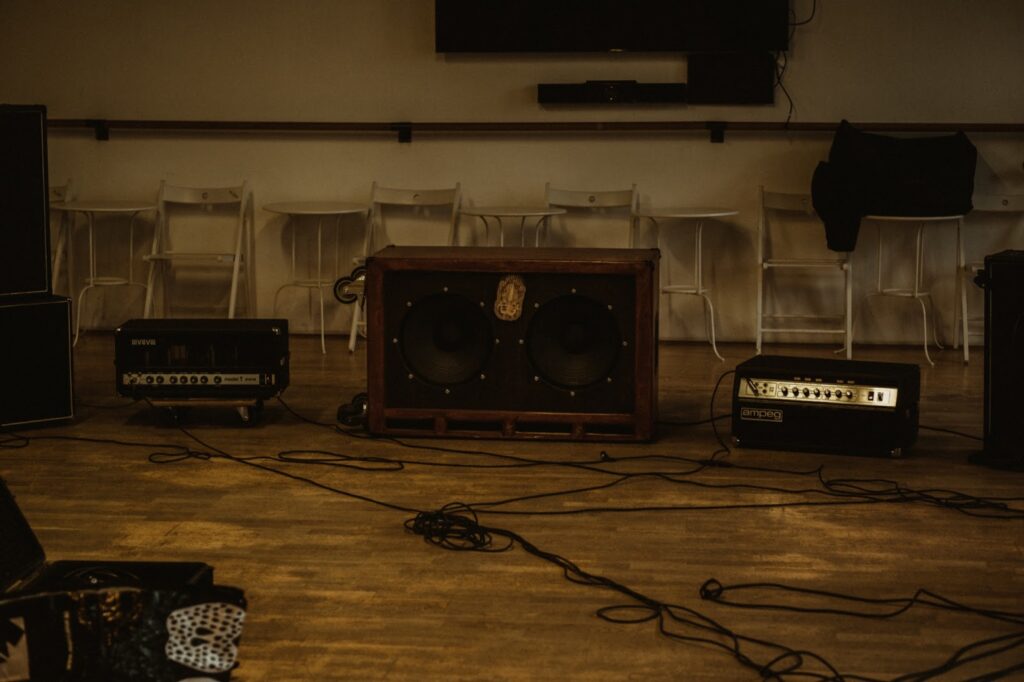
above: Backline, 2025 [photo by Primož Bončina]
Stories are created and wrapped on top of it. I suppose that’s not so uncommon in, for example, folk music; you have the drone and then you have the story that’s being told above it. In our case, it’s more of an experiment, trying to see where things can grow. And then if something seems to work, “Okay, let’s maybe pursue this one.” Trying to approach the work with an open mind.
So you can take the narrative as a storyline. But it’s still placed within a certain landscape, so it’s like the environment influences the story and vice versa. What do you think, Phil?
Phil :: The paradox of it for me is that we’re trying to make something that’s not strictly based in time, but it’s drone-based and we’re tuning around each other: we get beating patterns from that. Everything I’m doing is just with a bunch of oscillators. They’re running continually so I start to feel some kind of pulse, or a feeling that something is being propelled. The oscillation itself is cyclical in its own way too.
That’s something I think about a lot, and really enjoy, when I play with Primož. These two things come up against each other: we’re not necessarily trying to make something move through a kind of conventional narrative of, say, A to B to C, but a narrative emerges in a different way. There’s still some kind of motion or momentum happening, but it’s less predictable in what the outcome is going to be.
Swimming in the motion of the momentum ::
Dave :: So, you’re almost letting the way the music moves in the moment kind of dictate how the story is going to go, right?
Primož :: When I hear some drone from Phil, I oftentimes know what I could play along with and/or feel my way around it. That’s been a part of the process for a while. I guess where Phil said he’s subtracting, I’m kind of adding, sometimes a bit too much! (laughs)
Dave :: That’s a good partnership, then!
Primož :: I am quite conscious of adding too much; it’s a classic trap. So it’s always a struggle to not add too many things that are not functional. From this material, the first half of the album, there’s a lot of things being added, mainly synthesizer (by me) and vocals by Karen (Golem Mécanique) on the first track and Dylan (Desmond) on the second one. These additions extended the tonal palette in the mid to high range.
Most of the live recordings that were initially recorded were a crucial thing and remained as the reference for everything added on top. It wasn’t a casual file exchange; it’s more of…we have a living, breathing backbone of music that’s been created in an actual physical space, and I think it’s very important to feel like it’s alive. I feel that’s quite important to have–at least for this project to have it. I don’t think this kind of music really works if it’s not performed in a space, like if the space doesn’t shape it. It might have to do with the fact that we both are relatively apt improvisers, comfortable with being thrown out there and swimming our way back.
Dave :: Well, let’s talk a bit about that because you had a particular space that you chose in which to record this album. How did you come to select that space and kind of seek that voice or that frame for your music for this album?
Phil :: I mean it was the one that was available to us… The music department at the university in Cork is in a nineteenth-century seminary. It’s up on a hill and looks over the whole city.
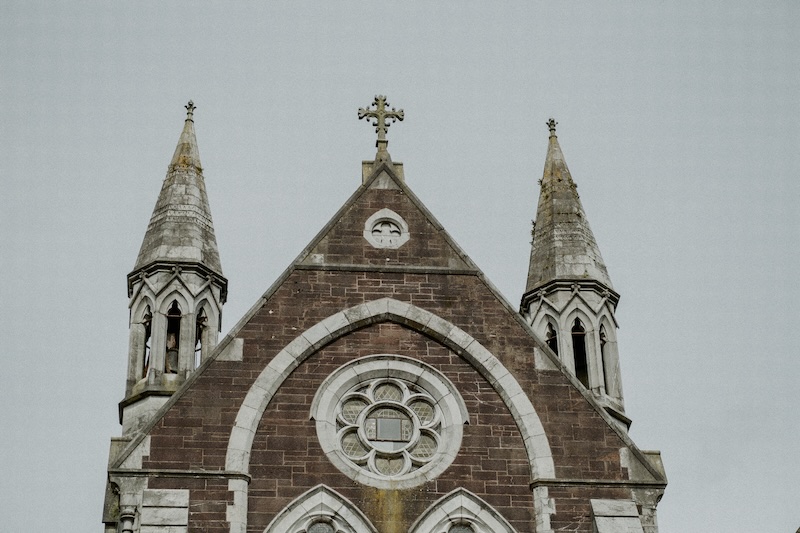
above: Roinn an Cheoil, Department of Music building. Cork, 2023 [photo by Primož Bončina]
Contemplation rooms ::
The studio is in the basement, and it’s a modern building inside, but everything is still made of stone and the doorways are still the original archways. Playing with Primož made me realize that even when I say that the work I’m making isn’t about anything and it’s solely about the sound, that isn’t the whole story. It’s also the space you’re in. For example, this old stone building that has a history and held a different significance when it was first built. It does change the way I think about this, the sound we’re making and how we’re making it.
Dave :: You know, for me, part of what makes a “sacred space” sacred is the way it makes you feel when you’re in that space, and the way it affects the sound and the way you feel that. Earlier Primož mentioned being in a forest and you have sort of an enclosed feeling. I think about in California, they have these redwood forests. And for me being in a redwood forest gives a very cathedral-like feeling, but it’s not always a positive feeling…you know, it’s kind of dead where you are at the trunk, down at the very bottom of the trees, but if you were up in the canopy it would be very different, right? Because there’s a lot going on up there.
But the feeling of sort of being drawn inward, compelled inward, almost like a—I always get these wrong, but “centripetal,” right, when you’re trying to concentrate stuff out of blood and it’s being pushed from the outside of a test tube toward the center as a machine spins it. You both mentioned seeking a center in your music. So I mean, for me, what Phil was describing there is an introspective quality to a lot of the music on this album and particularly on “Dolorosa,” with lovely ethereal vocals by Karen of Golem Mécanique. It just feels very contemplative to me.
Do either of you see your music making as a kind of contemplative practice?
Primož :: Absolutely.
Phil :: Yeah. For me, it is, definitely.
Primož :: Phil is the zen master. (laughs)
Phil :: Oh, I wish.
Primož :: I’m an eternal apprentice.
Phil :: My mind is always racing, which is exhausting. This kind of music is one of the few things where I can just be completely within something.
Primož :: Flow.
Phil :: Yeah, you can just be afloat in it, and maybe enter a kind of flow state of listening.
Dave :: Yeah.
Phil :: That’s why I think about Agnes Martin’s paintings a lot, because I feel like they expand into the room and you’re just within them when you’re looking at them. For me it really is that it can be that contemplative thing, of just finding or making a space that you can just exist within and there’s nothing else that needs to happen. There’s no goal. You’re not trying to achieve a certain state. You’re just in it, you know.
Primož :: Exactly a big reason why I enjoy playing with Phil; I think we both share this approach. This is also why you have to do it live, I think–to create a space, you need to be present. It can work otherwise as well, but feels a bit more detached and not as consolidated, I suppose. A space that colors and shapes the material produced. Getting into a flow state with the music. This term has been thrown around forever but personally it’s just something that has been a part of my practice forever. It could be liminal or it could be a giant wrinkle in spacetime. I wouldn’t say it’s necessarily liminal in this case. (laughs)
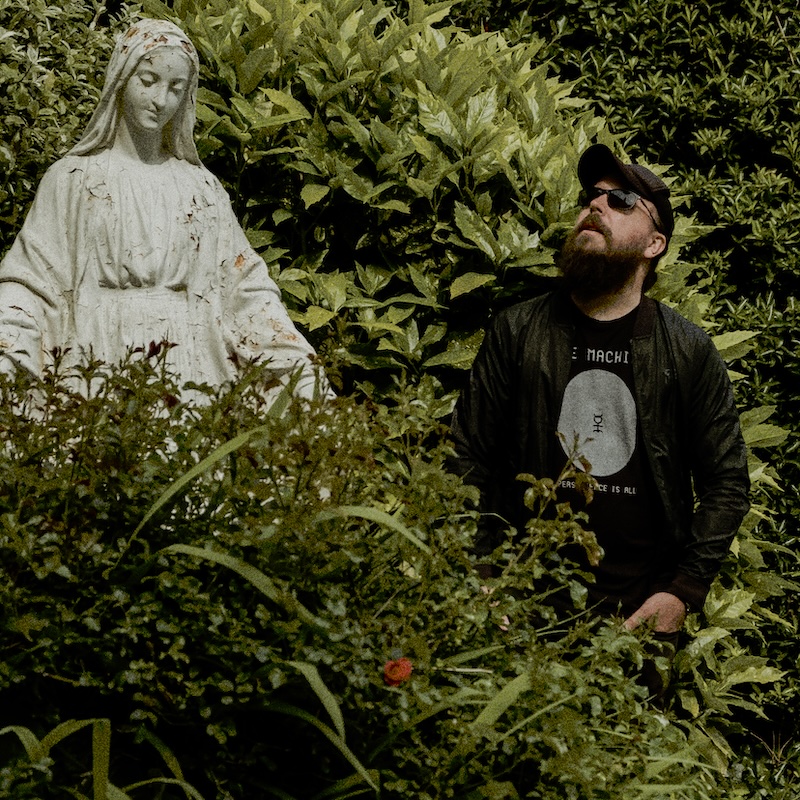
above (L-R): Mater Dolorosa, Primož. Cork, 2023 [photo by Sanja Rejc]
It’s a whole spectrum of intensities. When it comes to sound in physical space, it’s definitely creating a shared space and moving within it, if you will. I find that very rewarding and that’s also the place where you can kind of start telling a story maybe, if you feel like it.
Primož :: You mentioned Karen, and her Golem Mécanique.
Dave :: Her music is so amazing; so intense and spiritually charged.
Primož :: We are very fortunate for her generous contribution on “Dolorosa.” This first track on Stone and Worship is actually the first thing we recorded when we set the whole studio up. Just starting off, got everything hooked up and bam! Going straight in. I think it’s a good start for the album as well because of its slowly encapsulating and expanding layers.
Karen got the material; we were doing that one via file transfer. So it is a more introspective section; she got the track and I proposed the working title of “Mater Dolorosa” to her, which she found inspiring. What can I say about her stuff? She is an incredibly talented artist, a very kind person and a good friend. I thought of her immediately when listening back to that section, it sounded like it was made for her. And I love how that first piece just took on a life of its own. It’s more about how the material spoke to her. And what she felt is very complementary, so it’s a good example of an organic process where adding things can work well.
Dave :: Karen fits with you guys very well because she often has this almost sacred aspect to a lot of the music that she makes, like she’s exploring things in a very introspective, thoughtful, spiritual way. And then she’s very inspired by film also, as Primož is, so that just fits really well. One of her most recent albums, Siamo tutti in pericolo, is all about an Italian filmmaker whom I had never heard of (Pier Paolo Pasolini), but it’s beautiful music.
Primož :: And the second track, (Vangelis) Acolyte, so happy to have Dylan (of Bell Witch) do vocals on it, what a guy! And what an amazing contribution from him. Actually, seeing Bell Witch in Berlin perform Mirror Reaper (with Erik/Aerial Ruin on vocals; see Mirror Reaper) made me realize there is a lot of potential to be explored with massive guitars (in his case, a massive bass!) and storytelling. Definitely a huge inspiration as well.
A gradual devolution ::
Dave :: So if I had a story that I would be telling about your album, Stone and Worship, one of the things I feel as I’m listening to the whole of it is kind of a gradual evolution or devolution, maybe from one mental state or state of being or period of time to another. We mentioned cyclical aspects of time. I feel all that as I sort of go through these tracks on the album. And it’s almost like, when I’m listening carefully to each track, I get a feeling of kind of standing and staring deeply into the void. Whether that void leads to some other world beyond or whether that void is kind of inside yourself and you’re taking a look, you’re pausing, you’re being in the moment, right? And that gives you the time and the energy to do that looking. And then you’re changed, you’re moved. I was moved, you know, after listening to these tracks and feeling this way.
If that’s not too far off the mark, do you intend for your music to evoke some kind of reaction like that? I mean, I would call it spiritual, I think; others might prefer to call it psychological or maybe something else. But is that feeling something you go for when you’re composing or improvising or whatever?
Primož :: For me it’s a little bit of a philosophical question, but maybe also, like, everything is a vibration, right? So you know, it’s working on another level; like music can be more physical as well.
Dave :: Well, just to give an example, right? “Om” is the sound vibration that created the universe according to some religions. (Joachim-Ernst Berendt has some nice discussions of this in his book The World Is Sound: Nada Brahma [Destiny Books, 1991].)
Primož :: The vibration is the universe….
Dave :: Yeah.
Primož :: How does this matter “stick” together, electrons moving around the nucleus? There is definitely a frequency to the energy. However, sound waves moving through air are not necessarily super tangible to understand with our bodies. Unless it is pushed enough that it can be physical, such as standing close to the speakers during a live concert.
I use the term, like if you imagine a hologram; not a visual one, but one created with sound waves. If you visualize the vibration, the frequencies that are happening in the room. It’s kind of like a spectral temporal sculpture in that sense, that’s it’s constantly evolving and changing shape as well. So it’s kind of a fountain. There’s this work by an artist I really love, Olafur Eliasson, called Model for a timeless garden (2011; see link). It is a visual piece, but it aims to capture the shape of a water fountain by freezing it in time with the help of a strobing light in a dark room. The sound that you hear, however, is from an uninterrupted stream of water. Like that piece, it is only using the properties of certain matter to push it into new forms, not creating it of its own. Consuming electricity more like, with electronic instruments, in our case.
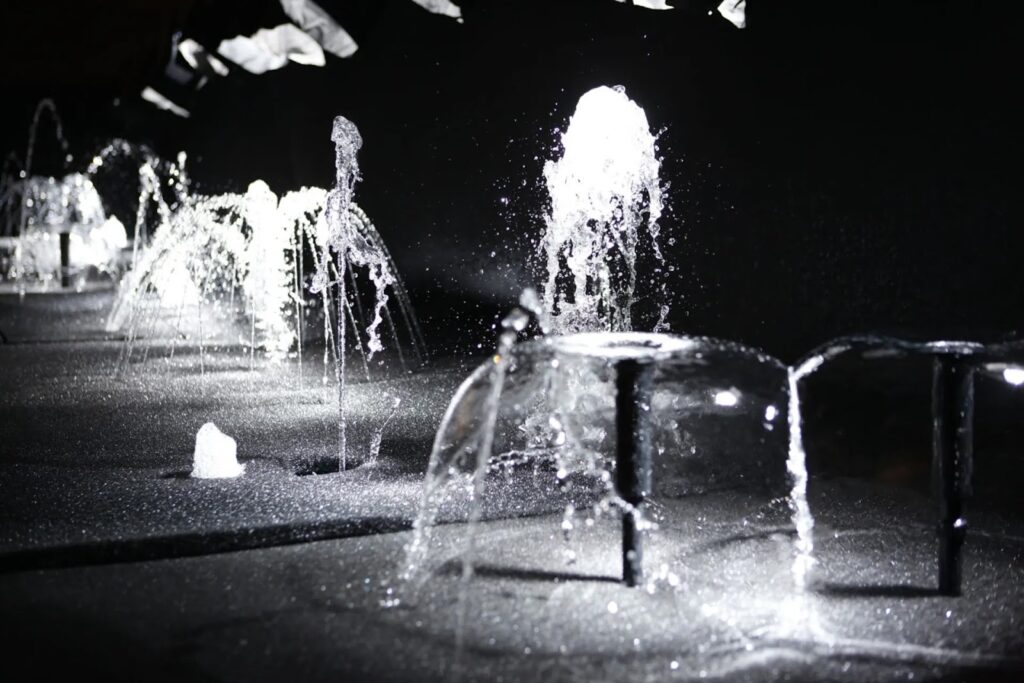
above: Model for a timeless garden (2011) by Olafur Eliasson
We are making matter vibrate. So in that sense we are evoking properties of, let’s say space, or however you would call it. Mainly using it as a transmitter for this vibration. What do you think, Phil?
Phil :: I came to this through Phill Niblock’s music (link). When I was a student, I had a couple of professors who knew him very well and had worked with them. So they invited him over to where I was studying (Brunel University, London) and put together a big ensemble of staff and students. We played a couple of his pieces.
I’d never heard of him or his music, but it was explained to us by Bob Gilmore, the late musicologist, who organized it. He explained it as these big drones; they’re very dense and there’s lots of layers, and that’s what happens. So if you’re up for that then just come along to the rehearsal room.
I went down and the first time I heard it was when we were playing it and it was a real life-changing moment. The feeling you get from all this vibration happening in the space was something completely new for me.
The psychoacoustic effects that come out of it as well were amazing. I have a vivid memory of that rehearsal. At one point I could have sworn someone was playing a real bluesy harmonica solo. But there was no harmonica; it was just where I was sitting in the space and the way everything was reflecting and interacting as it hit my ears. My parents came to one of the concerts, and my mom said to me afterwards that she’d heard all these hymns she sang as a schoolgirl in the music.
So there’s all this stuff that happens. Even if you don’t intend for these things to be evoked. You might not intend to evoke anything, but it still happens. That’s one thing I’m really interested in: the physical vibration of something triggering something much more internal. I try to bring these things to the music Primož and I play together, and see how they work with the narratives that come from our project. Especially the idea of memories being evoked that can run parallel to that narrative of the pieces.
Psychoacoustics, harmonicas, Niblock ::
Primož :: Yeah, psychoacoustic experiences are really curious. I’ve been going to this specific place every sundown and recording the birdsong and environmental sounds with a pair of sensitive microphones. It’s close enough to this village so that the evening bird choir mixes with various activities, among others an evening round of church bells coming from higher up in the valley. The combined overtones and resonances with all the other activities can make it into a quite surreal experience and sometimes the frequencies gel into something completely out of context, a third harmonic or a sequence of sounds that are created out of the properties of how the source sound behaves acoustically. So it was a reflection of the bells and birds and wind and traffic, creating this harmonic piece. I tend to leave and forget these recordings and return back to them sometime later, even more out of context, and try to hear if the material speaks in the same way. Recording things is curious in that sense.
Dave :: It’s cool and it makes it makes me feel better to hear you say that, because a lot of times when I’m listening to particularly slow minimalist, droning kinds of music, I feel like it sets my imagination free in a way that when there’s words or when there’s a whole lot of instruments or whatever, I feel more constrained. What I can imagine just opens up. I think Phil was describing taking stuff away from the music to get to the center of it, and for me that leaves a lot more space for the listener to kind of fill in with their own imagination. Like when Phil was describing how you heard something when you were doing that performance with Phil Niblock and then your mom heard something completely different, but that’s internal, right? That’s your memory and just how the music strikes your own particular ears.
I think maybe you’ve already answered this, but we’re getting toward the end of my questions and this might be a good kind of closing thing. Do either of you have a particular goal or goals that you want to achieve with your music?
Phil :: No! I don’t remember if it was a realization or decision, or maybe a combination but as soon as I let go of trying to have a specific goal–whether it was a practical thing like I want to this recording to be released in this kind of way, or I want to play in some specific place or with specific people–as soon as I let go of that stuff, it all made a lot more sense. Making music and playing music felt less rigid once I let go of that. Hearing the sound, experiencing it and exploring it is enough. That’s more than enough.
At the moment where I am now, I don’t see that changing. The removal of that way of thinking about it was the best thing I did, and it makes projects like this one with Primož really rewarding because all of these unexpected things happen.
Dave :: That’s great! How about you, Primož?
Primož :: Global enlightenment.
Dave :: We can hope!
Music as vehicle for shared experience ::
Primož :: I think the message comes across for that. But it’s not something that’s calculated at all; it’s a reflection on the human condition. We really need to perform this stuff live, to see it in a moving form. Great shows, for me, have this intent. It can be quite rewarding for the audience, consolidating a reality that we all share. If we all have this simultaneous experience, this one thing at the same time that is so primitive and basic like a drum beat, or a drone, it can transcend the need to agree or disagree on whatever.
It boils down more to the basic reality that doesn’t always come across to us. The more disenfranchised us humans are, the harder it is to understand that. But in those situations I don’t think you can really disagree on the basic experience. But I mean, after all, the album is like a genie in a bottle. It’s packed and coded into these digits, and replicated. In that sense it is not alive anymore; it’s a ghost of a ghost. Of a living moment.
Dave :: It reminds me of how Native Americans describe what it’s like to have their stories written down and put in a book on the shelf versus having the actual storyteller performing live with the audience, telling the story in the moment and then changing the story depending on who’s in the audience. What they want to emphasize, you know?
Picture yourself in the far North; there’s no TV, it’s very cold, and so you’re entertaining each other with storytelling. But maybe there’s also a message that one of the listeners needs to learn, so the storyteller tweaks the story to emphasize that message. (For a great ethnographic source on Apache storytelling as a way to convey a moral message see Keith Basso’s book Wisdom Sits in Places [Univ. of New Mexico Press, 1996].)
Primož :: Yeah, it depends on the vehicle. But it’s more difficult, if you have a more crude instrument, like we are using, for example.
It’s more difficult to disagree with the droning frequency, I think, although you can…. That reminds me of this journalist that listened to Phil’s drone set on our “Spectral Chimeras” event in 2022. He came for Aidan [Baker], mostly. Yeah, different listeners have different experiences. I remember this guy was like, “Drone. This is so boring.”
Phil :: He disagreed, pretty hard.
Primož :: Yeah. Yeah. Those drones were completely transcending but he didn’t transcend. So I guess for transcending you also need some kind of mental openness or at least not to have preemptive expectations or judgement. It can be hard to do, all of that.
Dave :: I think so much depends on the listener. And them being willing to actually listen openly, without prejudice, but that’s hard. Like we all come with a point of view. For example, I’ll take my students on a soundwalk and we’re just walking through a neighborhood near campus listening, right? And we all hear the same things, theoretically. But what each student focuses on is very different. When we share what we heard during the walk, one will say, “Oh, there was a dog barking at us,” or “There was a roofer nailing shingles onto the roof.” But another will say, “I was hearing the shuffling of our feet and I was wondering what it sounds like when ants walk.” I mean it really depends on the person, but I like your idea that the music makes it possible to have a shared experience.
Personal narratives ::
Primož :: The interpretation is another thing, then. Yeah, for sure. Like your expectations and the narrative that you came from, you come to the situation with.
Dave :: I almost wish that after you perform this album as a concert, I wish there’d be time afterwards for people to sit and share what the music made them feel or think about during the performance. I want to host a discussion like this after I show a film, you know, for example, like a film called Flow (film trailer). It’s a beautiful animated film with a little black cat as the star. The filmmaker, Gints Zilbalodis, had very little money for it, and he made the whole feature-length film with Blender which is this free open-source animation software. And you know, I showed this film on campus and I would want to talk to the students afterward and ask them, “What did you think about it? What did you get out of it?” But everybody goes home, you know, that’s just…I don’t know, I wish there were kind of the moment to have that shared discussion.
Primož :: That’s a good point, like a concert. If you listen to a good concert, at the end, you have all this stuff going on, you’re kind of processing it. And it’s, like, everybody goes home or to a bar. It’s strange in a way but it seems this is the norm. You can silently meditate on it or internally process it, which is, I mean, maybe that’s good enough. Locking it into a little personal box? Haha!
Dave :: I’ve really enjoyed learning more about this album and how you guys work. But is there anything we haven’t talked about that you wanted to share about this album, or your music, or anything else?
Primož :: Looking back as far as Stone and Worship is concerned I think it has been a successful release. We’re hoping to do more stuff together soon.
Phil :: In January 2025 I went back to Ljubljana and we made a bunch more recordings, in a big dance studio space there. We really got to push the volume this time. I hope we can make something from them.
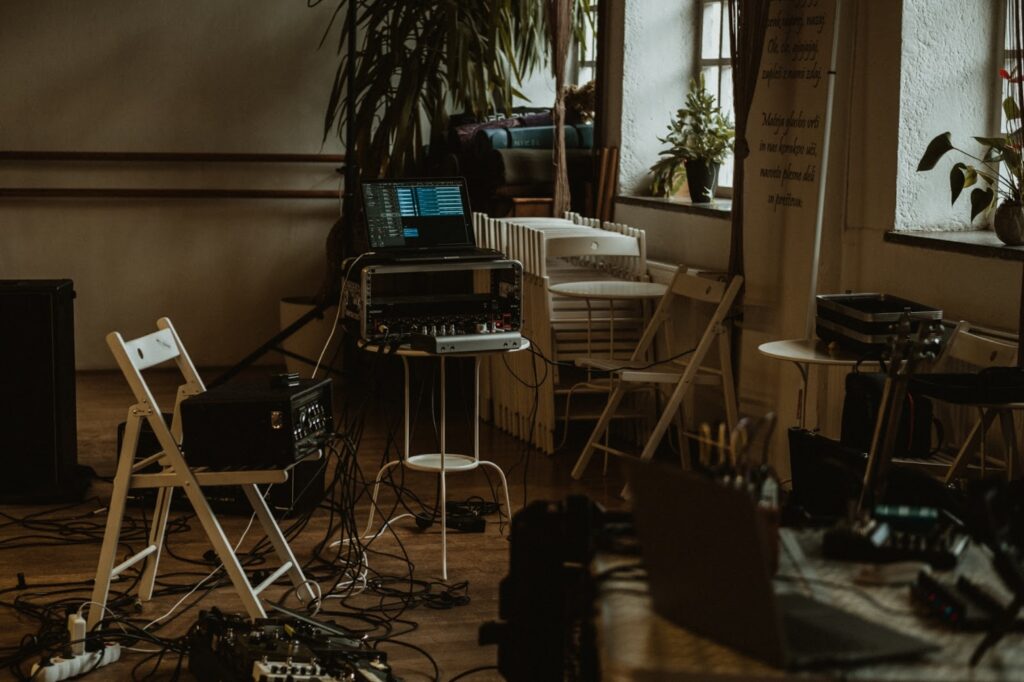
above: Recording Sessions PM/PB. Ljubljana, 2025 (photo by Primož Bončina)
Going sparser ::
Primož :: Stone and Worship was an exercise in exploring this language. It turned out to be more ornamented than we initially thought. Even the more sparse tracks, if you listen to tracks three and four (“Stone” section), there’s also a lot of stuff going on there and it’s still just the live takes mainly. Turned out great, though, and we are happy to have pursued the material in that direction, it was rewarding in the end.
So, the new material is a little bit more drone oriented, I would say, and more focused on different concepts. More focused on the material and the qualities of the material and observing. More of a focused meditation on the fabric, its densities and capturing those properties. Less narrative in a traditional sense.
Otherwise, we’re hoping to do as many shows as possible, circumstances and schedules permitting. That would be really cool to do, I think.
Phil :: Yeah. Yeah.
Dave :: That’s great. Now, I’m thinking about the album cover, right? With the kind of slanting light and seeing the dust motes, and now where you’ve talked about music being vibration. I’m thinking about those dust motes as contributing to the music in some way, you know?
Primož :: And the cold stone floor! As raw material as it gets. That cover art picture was from Spain, from the old cathedral of Salamanca.
Dave :: Beautiful! Thank you both so much!
Stone and Worship is available on Cloudchamber. [Bandcamp]






![[2View] Maps and Diagrams’ beneath still stars (handstitched*) & returning light (Home Normal)](https://igloomag.com/wp/wp-content/uploads/2026/10/maps-and-diagrams-returning-light-beneath-still-stars_feat-75x75.jpg)