


Fifty years after Autobahn, they’re not reinventing themselves—they don’t need to. The ideas, sounds, and structures they laid down decades ago still feel relevant, even necessary.
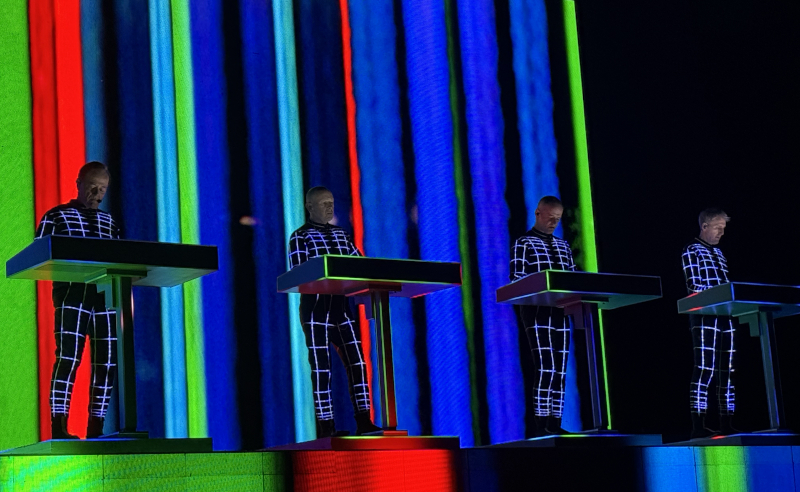
Movement, machinery, and rhythm
Kraftwerk returned to Portland on April 6 with their Autobahn 50th Anniversary Tour, converting the Keller Auditorium into a streamlined audio-visual engine room. The performance marked a rare opportunity to witness one of electronic music’s foundational acts revisiting the album that launched them onto the world stage.
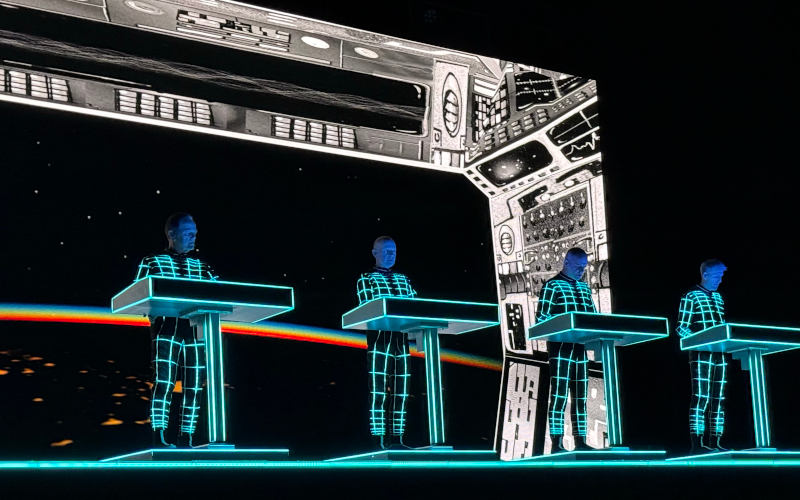
The current Kraftwerk lineup features Ralf Hütter, the band’s founder and only remaining original member. He’s steered the group since its inception and remains its steady voice and vision following Florian Schneider’s departure in 2008. On stage with him were longtime collaborators Fritz Hilpert, Henning Schmitz, and Falk Grieffenhagen, each posted behind sleek workstations. Their presence was understated, in keeping with Kraftwerk tradition—movement reduced to nods and slight gestures, letting the machines and visuals take center stage.
They opened with “Numbers,” its clipped vocal samples and mechanical rhythm still effective in a live setting. “Computer World” and “Computer World 2” followed with bright, flashing typography and grids sliding across LED screens, linking the group’s early ’80s fascination with data systems to today’s algorithm-driven lives.
Tracks like “Home Computer” and “It’s More Fun to Compute” retained their sharp, digital minimalism. Hütter’s vocoder-filtered vocals sounded untouched by time, and the sonic fidelity throughout the evening was clear and forceful—no reinterpretations, just finely calibrated live versions of the originals.
Finely calibrated live versions of the originals ::
“Spacelab” brought colder hues and orbital satellite imagery, a nod to the band’s long-held interest in both real and imagined futures. “Airwaves” and “Tango” shifted into more minimal territory—shorter pieces that served as connective tissue before the night’s centerpiece.
When the title track from Autobahn began, Kraftwerk widened the visual scope. Video of highways, vintage cars, and simplified maps stretched across the background while the band performed the track nearly in full, with extended sections echoing its original 22-minute runtime. Rather than reworking it, they presented it faithfully—both as a document of 1974 and a signpost of what was to come.
From there, the set moved into selections from The Man-Machine, Electric Café, and Computer World. “Computer Love” and “The Model” still resonate, especially given today’s ever-blurring boundary between human and interface. “Neon Lights” slowed things down, bathing the stage in soft color, its quiet optimism contrasting with the darker tone of what came next.
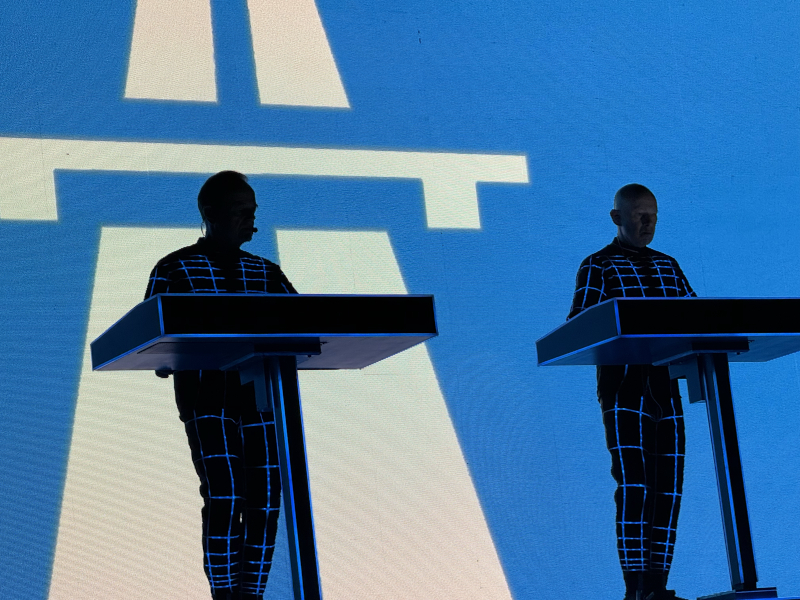
Stark visuals and a revised lyrical dedication ::
“Geiger Counter” and “Radioactivity” were performed with stark visuals and a revised lyrical dedication to nuclear disaster victims. Kraftwerk’s political edge has often been subtle, but here it was clear and deliberate. It also provided one of the evening’s few emotional breaks from the set’s otherwise cool precision.
A strong sequence followed with “Tour de France,” including “Étape 3,” “Chrono,” and “Étape 2.” The visuals shifted to stylized athletes cycling through rendered terrain, their timing synced to Kraftwerk’s steady rhythms. “La Forme,” “Trans-Europe Express,” “Metal on Metal,” and “Abzug” kept the momentum high—concrete beats, steel textures, and locomotive visuals that connected Kraftwerk’s ideas of movement, machinery, and rhythm.
The band’s iconic robot doubles made their expected appearance during “The Robots,” their limited motions mirroring the group’s own stage presence. It’s more ritual now than surprise, but still an essential part of the live experience.
The final stretch—“Planet of Visions,” “Boing Boom Tschak,” “Techno Pop,” and “Musique Non Stop”—served as a tight, rhythmic summation of the night. Kraftwerk stitched together decades of output into a seamless finale, fading offstage one by one as machines continued without them.
Kraftwerk will conclude the North American leg of the tour on April 24 in Dallas before continuing through Europe for the remainder of the year. Fifty years after Autobahn, they’re not reinventing themselves—they don’t need to. The ideas, sounds, and structures they laid down decades ago still feel relevant, even necessary.
Autobahn 50th Anniversary Tour.





![[2View] Nekomachi/no wonder • なるほど & tsubai/ilulissat (Perceptual Tapes)](https://igloomag.com/wp/wp-content/uploads/2026/10/nekomachi-no-wonder-tsubai-ilulissat-tapes_feat-75x75.jpg)