




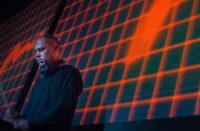

For over thirty years, Daryl Groetsch—best known as Pulse Emitter—has explored the interplay of noise and beauty, crafting electronic soundscapes where the mechanical and organic coexist. His latest release, Tide Pools, translates the intricate microcosms of coastal rock pools into shimmering, meditative electronic worlds.

“It’s not about the tools. It’s about the ideas.”
For over two decades, Daryl Groetsch has quietly mapped the vast emotional and textural range of synthesized sound. From his earliest tape experiments in the late ’80s to his latest release Tide Pools, Groetsch—best known under his moniker Pulse Emitter—has explored the tension between noise and beauty, the mechanical and the organic. His work bridges New Age calm and cosmic abstraction, crafting worlds where analog hiss and digital shimmer coexist in perfect equilibrium.
Groetsch’s fascination with electronic sound began long before modular synths became fetishized objects. Started as a child doing tape experiments using multiple boomboxes. “In high school, I had a four track and a bunch of effect pedals, and used to do experiments with that, just making noises,” he recalls. “Later, when I went to college, I started actually getting into synthesizers, and that I owe, in large part, to an electronic music class that I took. They had an electronic music studio there at the college I went to Missouri State University and then I started buying synthesizers. [Roland] Juno-6 was the, the first one I had that was really something that I got into, big time. Caught the bug with that one.” By 2002, he was hand-building modular synths, chasing the dream of sculpting sound from raw voltage. Over time, however, he began to embrace software, not as a compromise but as liberation.
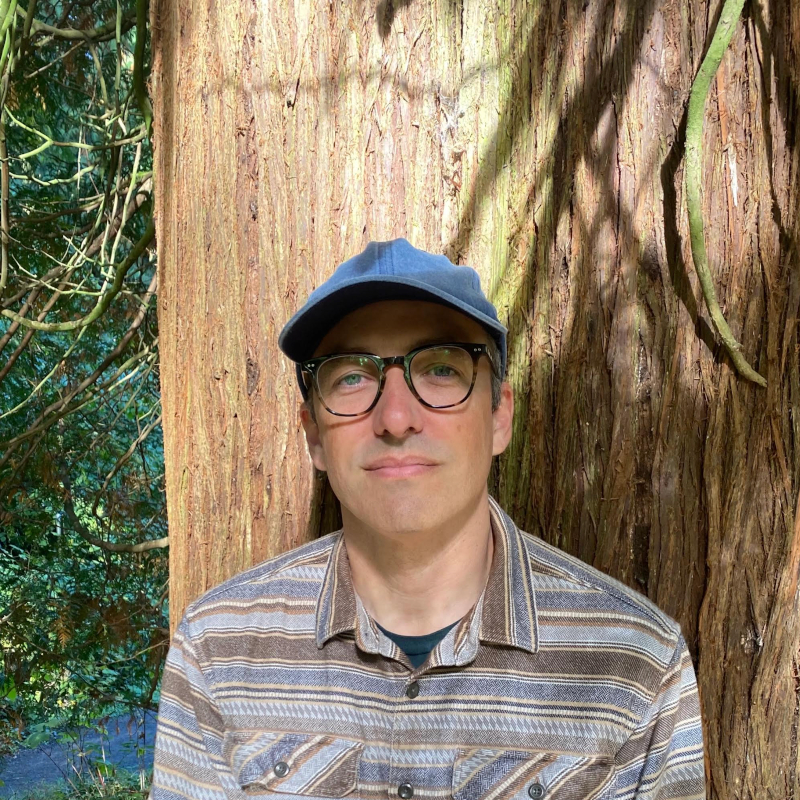
“It’s not about the tools. It’s about the ideas,” Groetsch says. “I don’t have to be in my studio or whatever. I can just work on music anywhere, and I do, and that really works for me. I’m much more productive now.”
That balance—between intuition and engineering—defines Groetsch’s catalog. His music is as informed by scientific wonder as by personal reflection. Early on, Revolution No. 9 by The Beatles cracked open his sense of what sound could do. Later, the ethereal calm of Ray Lynch’s Deep Breakfast and Enya’s Shepherd Moons shaped his melodic instincts. Radio programs like Hearts of Space introduced him to the meditative drift of ambient and New Age music, though he would soon pull those forms into more experimental terrain.
When asked what drives the conceptual side of his music, Groetsch speaks less about emotion than observation. “…living in the Pacific Northwest as well, kind of can’t help but be overwhelmed by the natural beauty everywhere. And that sort of thing definitely inspires me,” he says. Also cites reading about ecosystems, or just watching the ocean, can lead to an album idea.
Structure meeting drift, design chance ::
His new release Tide Pools (on Hausu Mountain) emerged directly from that interplay. Inspired by the microcosmic worlds found in coastal rock pools, the album translates tiny aquatic dramas into shimmering electronic tones. “…looking at tide pools and thinking about how they’re like these little worlds with all this activity going on,” he explains. This became the framework for the album.
The resulting compositions are cinematic yet understated, using silence not as absence but as structure. Groetsch wields negative space like light through water—each pause a refractive shimmer that deepens the album’s sense of depth. “There’s some tracks where there’s quite a bit of silence,” he notes. The influence of American marine biologist Rachel Carson’s The Sea Around Us lingers throughout, infusing Tide Pools with a sense of ecological wonder. What emerges is an ebbing, breathing organism of sound—Groetsch’s intricate synthesis forming a living, tidal tapestry that shifts and evolves in perpetual motion.
Though known primarily for his electronic work, Groetsch occasionally folds in field recordings and acoustic textures—creeks, waterfalls, and percussive elements that blur the line between natural and synthetic. He uses field recordings creatively, not literally. “I recorded some waterfalls and creeks into a sampler – So it’s very slow and very low pitched. So, it just sounds like this, slow motion gurgle.” Instead, he treats environmental recordings like any other instrument—filtered, looped, or reimagined until they dissolve into the sonic fabric.
On Tide Pools, that fusion of nature and technology extends to the visual presentation. The album’s artwork, designed by Max Allison of Hausu Mountain, reflects a fascination with marine biology and cybernetic imagery. “It fits the concepts of oceanography and technology all in one image,” Groetsch notes. “…His artwork is always an option, and I always go with it because I love it.”
In conversation, Groetsch comes across as quietly methodical; someone who has spent years refining his process but still approaches sound with curiosity intact. His workflow today is almost entirely digital, using MacBook and iPad-based instruments that can emulate or exceed the possibilities of the modular rigs he once built.
“I really prefer using laptops and iPads, because I really like being able to just hit save and close it and open it up and everything’s right where I left it. And just being able to work on the go, was a real game changer for me,” he says. “…the more mature as an artist and able to exercise the creative muscle more reliably, I just want what’s the most powerful and the most convenient, and that is hands down software.”
Still, despite embracing software, he hasn’t abandoned his tactile sensibility. Pulse Emitter performances and recordings retain a sense of presence; structure meeting drift, design meeting chance. It’s this tension that gives his work its unmistakable glow: a serene futurism grounded in the natural world.

Little worlds with all activity ::
Groetsch’s discography spans over fifty releases, from early noise experiments to lush ambient soundscapes. But the last few years have seen him distill those impulses into two parallel projects: Pulse Emitter, his long-running progressive/experimental identity, and Daryl Groetsch, a newer alias devoted to pure ambient space music. Having separate projects helps Groetch explore different moods. “Pulse Emitter is where I can do whatever I want and be experimental and Daryl Groetch is where I just do the calming ambient music that I love.”
The continuity between those worlds mirrors the arc of Groetsch’s career. Whether through buzzing modular tones or glistening software patches, his music retains a sense of optimism; a rare quality in an age when ambient often veers toward melancholy.
“I tend to be optimistic,” he admits. “Even when the sounds are dark, there’s always light in there somewhere.”
Outside of his own work, Groetsch’s current listening habits reflect his wide-ranging tastes. Lately, he’s been drawn to Mathias Grassow, the German ambient mainstay known for deep, meditative drones, and Kit Watkins, a keyboardist from the progressive rock groups Happy the Man and Camel. These artists, like Groetsch himself, inhabit the intersection of composition and exploration, where structure meets surrender.
Looking ahead, Groetsch shows no signs of slowing down. He’s working on a fully microtonal album for Pulse Emitter, an exploration of scales that step outside Western tuning and a new ocean-inspired ambient release under Daryl Groetsch. Both promise to push his sound further toward abstraction, yet remain rooted in the wonder of the physical world.
From basement tape loops to oceanic drone symphonies, Daryl Groetsch’s journey through electronic sound continues to expand outward and inward at once. Tide Pools feels like both a culmination and a beginning—a calm surface concealing immense depth beneath.
Tide Pools is available on Hausu Mountain. [Bandcamp]