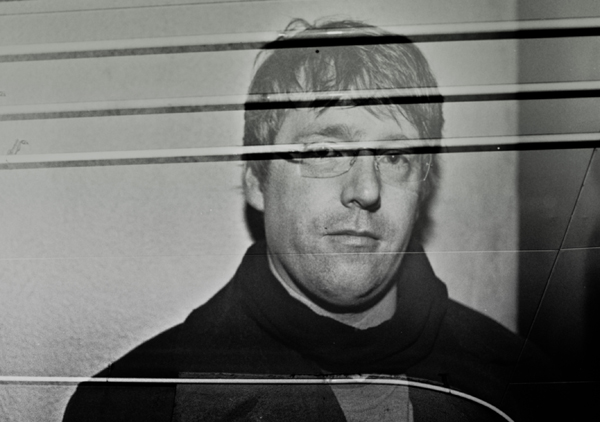







Oliver Stummer (Oct 13, 1974 – Dec 3, 2024), most notable with his Tomoroh Hidari alias and releases, passed away suddenly in early December 2024. He also released as Death Librarian, The Dubnihilist, his Namelessness Is Legion, and left a vast treasure trove of sonic ingenuities and perplexing alien absurdities in the realm of contemporary electronica, most of which are difficult to categorize elegantly.
Sonic ingenuities and perplexing alien absurdities
Oliver Stummer (Oct 13, 1974 – Dec 3, 2024), most notable with his Tomoroh Hidari alias and releases, passed away suddenly in early December 2024. He also released as Death Librarian, The Dubnihilist, his Namelessness Is Legion, and left a vast treasure trove of sonic ingenuities and perplexing alien absurdities in the realm of contemporary electronica, most of which are difficult to categorize elegantly. We learned about his passing as everyone else via social media, in disbelief and denial. Oliver released much of his individual output via his own Ivory Bunker, as well as Schematic Records, Mahorka, Isolate, and others, and had a bond with the Bulgarian electronic scene since 2004, when he visited and played in Sofia for the first time.
Through the live scene here he came to publish many of his releases via Mahorka, most notably under the alias his Namelessness Is Legion, starting with Resonant Mindlessness (2006). The following essay was commissioned in 2018 for a book where it eventually did not fit and is an autoethnographic reflection on his musical practice and the different stages of his work, ranging from his participation in Kreuzweg Ost to his Lovecraftian passion, synth hacks, and software bugging, to and anything Japanese and cute. Oliver’s connection to the Bulgarian scene was a vivid and fruitful one, and the following text is a co-publication with Comfort Club: An Annual Zine by Amek Collective, No. 6 (2025): 16-23. We publish it in memory of his work and creative impulse.
Wounding of the Bright
Oliver Stummer
1. Edelrost
“Die Geschichte die wir erzaehlen wollen ist sehr lange her. Sie ist sozusagen schon ganz mit historischem Edelrost ueberzogen und undbeding in der Zeitform der tiefsten Vergangenheit zu erzaehlen.” Kreuzweg Ost, “Edelrost”1
I remember my first composition. . . Actually, I don’t. Not quite.
What I remember is that sometimes aged around seven–eight, somewhere in the early stages of learning the violoncello, I went ahead and scribbled a bunch of quavers, semi quavers or what have you in between, above, and below five vertical lines. When I showed it to my teacher, she said that it was unplayable. As in: physically impossible to perform on a cello. I don’t think I quite understood the potential of unplayable music at that time, but it nonetheless made a big impression on me. And I would return to some aspects of that idea later, after I had discovered ‘Pataphysics, the science of imaginary solutions, and a major influence on my work. And when working on a computer, I was able to calculate the music that can’t be played.
But before that came teenage subversion: the evils—or so my mostly catholic, somewhat conservative social background saw it—of heavy metal. Naturally I started learning the guitar and, with fellow schoolmates, formed a band. That was Khazad Dûm. Over time we went more neo–prog than metal, an unconscious subversive act in itself at a time (late 1980s/early 1990s) when metal became mainstream and soon after grunge got big. Not everyone thought we were cool. But through this I became comfortable with being an outsider of taste, with doing my thing even when there are few around me who share my predilections or understand what I’m on about. An important foundation towards finding your own style with confidence.
Apart from leading down the rock band path, heavy metal also got me interested in the occult. (Ironically, probably more due to all the books and concerned individuals warning of this, than the actual music or artists). I never became a practitioner, but an eager explorer of its various tentacles, from magic traditions to Satanic or Thelemic religions to all the pulp–and horror–manifestations we find in popular culture (mostly the latter, if I’m honest). And that would, in various ways, find its influence into my music making over the years.
1 “The story we want to tell you took place a long time ago. It has, in a manner of speaking, been covered in a patina of noble rust and should, by all means, be told in deepest past tense.” Kreuzweg Ost, “Ederlost,” Ederlost (Cold Springs Records, 2005).
2. Also Spoke Zerothruster
Khazad Dûm ended when we all finished school. Following that I tried for a while to write songs and start bands. Goth and neofolk respectively were the genres of choice. But none of these attempts came to fruition.
But then I started to delve more and more into electronic music production and it was there that my musical career really began. That was in ca. 1998–1999 and in 2001/2002 my first tracks started to appear on a number of compilations. All from my main project and pseudonym Tomoroh Hidari (Japanese for “Tomorrow Left”—left as the abstract concept that depends on the direction of vision).

Stylistically these early tracks are still all over the place, but experimenting across different electronic subgenres, I eventually found my own style—a dark, often glitchy and disjointed sound which can be heard on my debut CD release, the mostly Lovecraft–, but also LaVey– and Crowley–influenced The Necrophonicon (2004), and on Alien Audio Absurdities (2008, but recorded in 2002). The title was a wordplay on The Necronomicon, Lovecraft’s fictional book of lore, the name of which supposedly translates as Book of Dead Names or Law of Dead Names. Hence, The Necrophonicon—with a nod towards Athanasius Kirchner’s Phonurgia Nova—being the book or law of dead sounds.
As conceptually high–strung as this may sound, the concept was rather loosely–applied, and mostly post factum. It did, apart from the arcane and dark imagery of song titles and a few of the vocal samples used, fit quite well, as a lot of the sounds were samples that were so heavily processed as to qualify as “killed” and machinized and as such robbed of any organic, humanized feeling.2 One track, “I Did It for Satan,” includes actual backward masking3 of messages created with a voice synthesis program, then reversed and further filtered to be almost steganographically hidden in the mix.
All this toying with tropes aside, while I enjoy giving my albums and tracks titles that sometimes sound conceptual, what shaped my music the most was the technical process of music–making.
I was mostly working “in the box” at that time, i.e., all with software synthesis rather than hardware synths, samplers, etc. I did occasionally borrow gear here and there, record my own samples, and then use them in production. This may have somewhat influenced my approach, in which I preferred more exotic (for the time, at least) synthesis methods: granular synthesis and the mangling of recorded sounds/samples in software such as Granulab, Audiomulch, VAZ Modular and later Reaktor and various VST/VSTi plugins. Part of my approach to making music consisted in hunting down obscure, often experimental software, buggy beta–versions that would bring unexpected results—glitch from a time before there was that much dedicated glitch software. I also started dabbling in Csound for a while, as well as playing around with (not so much programming my own) Pure Data patches.
All this made me favour a studio approach to music–making, and while I did perform live from time to time, working in the studio, and focusing on improving my recording and production skills was where my interest laid.
The follow up to The Necrophonicon, a 12” titled On the Verge of the Best Madness So Far4 was finished and set to be released on Isolate Records when Wai Cheng, who ran Isolate, sadly passed away in 2007. This was a bit of a setback and I stopped making music for a couple of months. A break from which I returned with a slightly different approach.
This can already be heard on the somewhat Janus–faced next release: Also Spoke Zerothruster (2008) on Record Label Records.
2 Isn’t sampling a form of zombification in that it brings sounds that, having been recorded, are no longer “alive” but instead static, back to a new, second life?
3 Backward masking is the process of hiding subliminal messages in recordings by reversing the recording and mixing it into songs in a way that de facto hides it from recognition. Google it for some fun.
4 This record remained unreleased until I released a digital download version via my own Ivory Bunker Recordings Bandcamp page in 2018.
3. Zum Appel
While most of the influences of Tomoroh Hidari up to Zerothruster (and later as well) can be found among the rosters of labels such as Warp Records, Schematic Records, SKAM, Mego, Ninja Tune, etc., I also never stopped listening to heavy metal and industrial. As a result, I found myself involved in the industrial side–project Kreuzweg Ost, of black metal musician Silenius (Summoning). He had founded the group with Martin Schirenc of Pungent Stench and they released an album together after which Schirenc left. Silenius kept Kreuzweg Ost going, and so Ronald Albrecht and I joined to record the next album, Edelrost, released in 2005 on Cold Spring Records.
The work process for Kreuzweg Ost at that time quite differed from what I was used to do in my solo work: rather than starting out with me experimenting with sounds, Ronald was producing basic rhythm tracks, mostly drums, percussion, bass, etc., and then giving those to Silenius who would work with them to compose melodies and riffs on the keyboard. Eventually I would come in and we would record those via MIDI and then start arranging the sounds around them, making heavy use of orchestral sample libraries and other virtual synths.
On very few tracks there are some beats and percussions I contributed, and there was some back and forth between us: somewhat developed tracks would go back to Ronald for additional beats/percussion, etc., and then Silenius and myself would work on the final arrangements. Usually at the beginning, before work on the actual tracks began, we had sessions where we would sample dialogues and sounds from movies, which would then be used on the tracks.
There was not a lot of experimenting going on, more so on Edelrost than on the second album I did with Kreuzweg Ost, by which the formula had been solidified.
4. (Resonant Mindlessness)
Kreuzweg Ost was not my only collaborative project. Apart from Müde, a project with the late Martin Witzmann, however, most of them were more one–off tracks or live acts, spanning a number of genres from hip hop to soul, dub, radio art, a highlight being the very noisy collaboration with Liesl Ujvary on an original Trautonium: Trautonium Jetztzeit (2008).
The second most productive of my solo projects, after Tomoroh Hidari, was his Namelessness Is Legion (hNIL). Now retired, this was, as I once described it, “Drone ‘Pataphysics for individuals with at least two ears.” And I think it’s worth mentioning here briefly.
hNIL emerged out of my growing interest in drone music at the time, especially influenced by the more electronic productions of Coil or Lustmord and leading to an exploration of the genre into its historic past as well as its present (we are talking 2000s here). A trilogy of albums loosely based around a radical–constructivist approach and/or referencing Umberto Eco’s The Open Work with the idea that the final composition is created by the listener (hence the Liz–Anna Trilogy) anew on each hearing. All three were released between 2006 and 2013 on Bulgarian netlabel Mahorka.
After moving to London in autumn of 2012, his Namelessness Is Legion became a vehicle for improv noise, often made on simple self–built oscillators and noise generators, modified gear and circuit bent toys. This approach of hNIL brought forth three releases: Fortytwo (2014), a forty–two minute long trip through field recordings, c–sound5 drones, and pulsating noise, as well as the Get Bent EP (2014 on now apparently defunct Schtoum Logic Records) and a limited edition tape (also as digital download) release of Astable Systems (2015) on Workin’ Klass Noize.
In or around 2015, however, I felt like there was not much merit to continue hNIL in its current form and decided to end the project. I might do some more improv/noise things again in the future, but at this point I don’t plan to revive hNIL again.
5 I never managed to fully get to speed in Csound. My use was mostly hacking patches (.sco and .orc files) hoping something would come out of it. Often, I broke them. I then discovered Cecilia and other front ends that allowed me to create sounds without too much programming. I still feel that for sound quality, or should I say aesthetics, it is among the best music programming languages.
5. Thy Will Be Done
Edelrost was initially supposed to be released, like its predecessor, on Napalm Records. But they pulled out and so we had to look for a label. After searching for a while, Kreuzweg Ost got signed to Cold Spring Records where both Edelrost, over a year after we had finished it, and its successor Gott mit Uns, were released.
Kreuzweg Ost was never a live band, much like Silenius’ other project, Summoning. And so, there was a long break before we went to record Gott mit Uns while Silenius focused on Summoning again. There was not much difference in approach on Gott mit Uns, except that we were using more English dialogue samples. And the topics became broader, from the focus on more militaristic and historic tropes on Edelrost, to a lot more mysticism and religious imagery.
I never involved myself too much into this side of the project, my main interest was always around the musical bits, about making the production sound as good as possible, giving it depth and sparkle. But it also became clear to me during the work on Gott mit Uns that I had started to grow somewhat dissatisfied. Unlike Tomoroh Hidari or his Namelessness Is Legion which always had a strong element of experimenting and exploration. Kreuzweg Ost, on the other hand, was very firmly anchored in the musical style and political as well as aesthetic tropes of Martial Industrial.
I did not at the time—and still don’t—listen to a lot of martial industrial. Partly because of the dodgy politics of some of the acts. Kreuzweg Ost was never overtly political, or else I wouldn’t have joined in the first place. It’s also my observation that, from what I gathered talking to artists and fans alike, a lot of the use of political imagery and tropes is around the idea of—some may it call “edgelord”—provocation, than an actual political stance.6 This does not change the fact that, while I feel that art needs to provide a safe–space for provocation, in this specific area it’s becoming stale and unoriginal and thus problematic for the very reason that not everyone involved sees it as provocation or “trolling.” And that rather than getting people to reflect, it often runs the danger of confirming those with dodgy views. Also, there is just not enough interesting going on musically.
And so, no longer getting much satisfaction creatively out of working with Kreuzweg Ost, I amicably parted ways with them after Gott mit Uns was released. Eventually I moved to London which would have sealed the deal anyway.
6 It has always been my understanding that this “flirtation” with and appropriation/recontextualization of fascist imagery originally came from decidedly left leaning bands like The Crass and was meant clearly as a provocative antifascist statement. It seems, however, that it is now mostly done or interpreted as support of far–right ideologies. Or am I wrong?
6. The Great Black Matter Swindle
With Tomoroh Hidari, I would move on from the faster, more beat–oriented tracks I had mostly been doing on the earlier releases. (I had found myself lumped in with the breakcore genre repeatedly, an epithet I never felt really fit: drum‘n’bass was a big influence at times, but I never wanted to do its classic forms. Some breakcore was also an influence, but more the drill‘n’bass stuff of Squarepusher, Luke Vibert, µ-Ziq or Aphex Twin, and more so acts, like Autechre, and the beforementioned Coil).
With the later releases, especially The Black Star Variations (2011) and Some Stars Not Yet Black Holes (2012)—both of which I post factum combined under the The Great Black Matter Swindle7 umbrella—I went into more ambient realms.
It is an open secret that I consider Some Stars Not Yet Black Holes to be my album length (and instrumental) reinterpretation of the Current 93 song “The Seahorse Rears to Oblivion,” its lyrics inspiring the title.8 Musically, it does not reference any of its melodies, but for me personally at least, they both have the same mood: a slow cosmic apocalypse.
Not long before the release of Some Stars. . . I released The Black Star Variations, which were all based around the original “Black Star #1” track that had been recorded a while earlier for Record Label Records’ Drinking the Goat’s Blood compilation.
The idea to create variations came only later, the #1 bit of the title of the first track being somewhat random at the time. It was after adapting the track for a live performance at the IMA (Institute of Media Archaeology), in the course of which the track mutated quite heavily, that the idea was born to create a whole set of variations: “Black Star #2,” of which there is a recording from the live performance, but which has never been released, was remixed into “Black Star #3.” “#3” got remixed to form both “Black Star #4 (Wormwood)” and the spin–off variation “Black Star Elevator” for Mahorka’s Music for Elevators Vol. 4 compilation. “Wormwood” was remixed to become “#5,” etc. For a while I was planning to do further variations, all the way up to 11. But eventually postponed the idea indefinitely. And then things somehow petered out. . .
Between sometimes in late 2015 until the fall of 2018 I completely stopped making music and am still only slowly working on new Tomoroh Hidari material. As I’m writing this, I’m not sure where it will go stylistically. Most of the work in progress is similar to the ambient pieces from before the break, but I’m not quite satisfied with simply leaving it at that. I’ll keep experimenting.
And then, of course, there are the days when I dream of starting a band again. It would probably have to be black metal with doom influences or vice versa. Nihilistic, free and loud.
7 The title under which I presented my ambient live acts where I played material from those two releases mixed with improvised parts. There are two live recordings available.
8 “The stars try and try and try to fly away from Earth / But God has caught them in a large sling that holds them from falling too near or flying too far / The Devil creates black holes / Sucks them out of the visible universe.” Lyrics from Current 93, “The Seahorse Rears to Oblivion,” The Seahorse Rears to Oblivion (PanDurtro, 2003). Written by David Tibet.
7. Everything Is Already Dead and Resurrected in Advance
From “dead” sounds to the vastness and vacuum of space (and a homage, not to forget, to sci–fi soundtracks and sound effects), I always try to push for new approaches to music–making, while never actually reinventing the tonewheel.
Rock‘n’roll (or any other style) has been declared dead numerous times, and I personally think that musical styles are “dead” on emergence, once they are understood as styles. This is when they get copied, when they become part of the shared world of musical possibilities, of the vocabulary of musicians. And this is usually when they thrive. And why it is fun to play around with them, trying to break the boundaries of genres. I think it was here that my personal approach differed too strongly from the approach Silenius took with Kreuzweg Ost. Where he always wanted to stay quite strictly within the confines of the consent of what defines Martial Industrial, I would have thought it interesting to experiment more and widen the scopes of the genre.
With Tomoroh Hidari I quite frequently sampled from releases spanning all kinds of Heavy Metal, usually processing these samples to create sounds beyond recognition. Similarly, some of the harmonic progressions of the synth drones on Some Stars not yet Black Holes were quite directly inspired by the howling–guitar wall of sounds you hear in Black Metal (which share similarity to ambient/drones at time). Far from the approach you find in Crossover, which combines the more obvious stylistic elements into, what I feel, is usually an infertile hybrid, I always find it more interesting to work on more subtle cross pollination. This, I feel, has a better chance to result in a genre–mutation that can further evolve.
Popular music is, I would like to think, without being an expert on Baudrillard, one of the sexiest incarnations of the hyperreal. Dead and resurrected in advance.9 Popular pieces of classical music, jazz, pop, rave or black metal: I have always seen them all as pop, which has influenced my approach to making music as well, mostly inspiring me to try harder to eschew, or at least toy with the formula of styles and genres: only through an act of transubstantiation does music become a common good which allows the listener to make it their own, to read meaning from and into it at the same time. Great popular music is a well–forged prism: shine in white light and you’ll start seeing rainbows.
London/Tokyo 2019.
9 Jean Baudrillard, Simulacra and Simulation, trans. Sheila Faria Glaser (Ann Arbor, Michigan: The University of Michigan Press, 1994), 6.
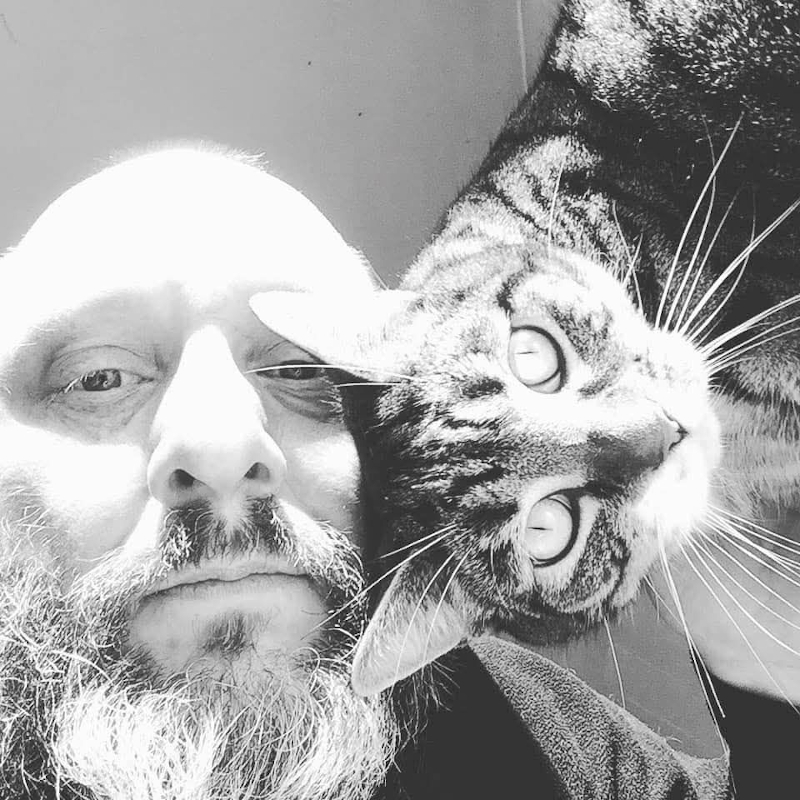
Photo of Oliver Stummer with his cat Schnitzel.