



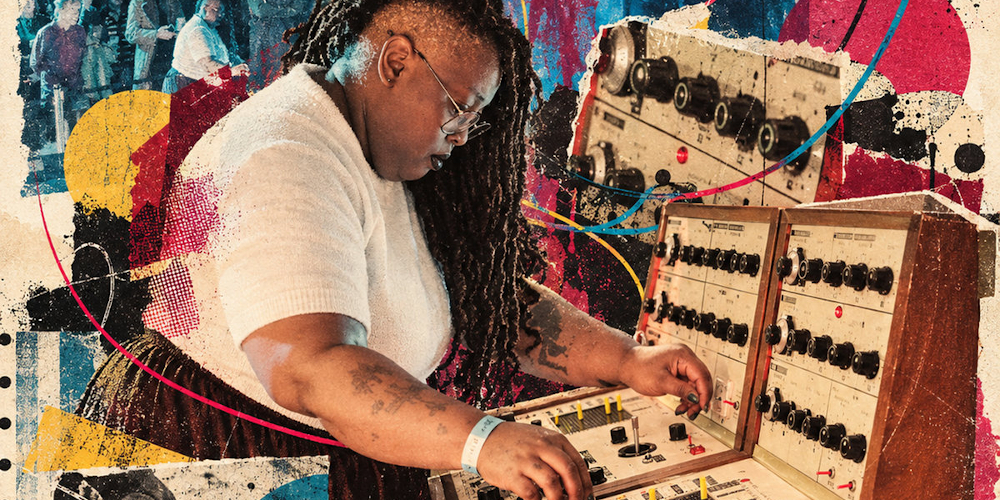



Trudi Veremu turns the vintage EMS VCS4 into a voice of her own, blending freeform vocals, experimental electronics, and diasporic memory into an intimate exploration of sound, identity, and the unpredictable relationship between artist and instrument.
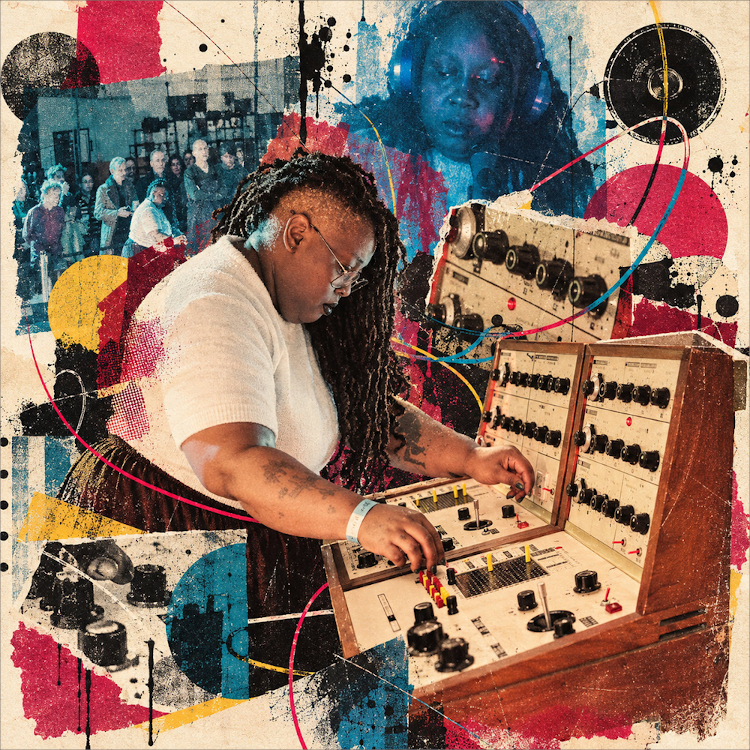
Trudi Veremu finds her frequency
The EMS VCS4 was built for Harrison Birtwistle‘s Medusa in 1970. No manual came with it. It moved from EMS’s Putney studio to the Royal College of Music, passed through the hands of a former student, got restored to working order in 2006, and finally landed at Goldsmiths in 2019 as part of the university’s modular synthesizer suite. Trudi Veremu (aka Thelma Rose) found it there while studying, and spent months, not days, months—coaxing sound out of a machine that resists being understood quickly. No manual meant no shortcuts. She measured, documented, drew her own maps back through it. She’s since described playing it as something closer to conversation than performance. Sound waves hitting each other. The instrument and her becoming one thing. That relationship is the entire premise of Session 145, and it’s audible from the first few seconds.
This isn’t the first Modulisme session covered here, and what separates Veremu‘s entry in the series immediately is the voice. Her vocals are the standout, and genuinely unique in this context, a soft, indie-leaning vocal quality run through tremolo and light processing, but freeform throughout. Nothing sits on a grid. Nothing repeats the same way twice. The opener “Im forever” runs almost thirteen minutes and shows that strength right away, tremolo amplifying both tone and emotion while the VCS4 does its own unpredictable thing underneath her, occasionally leading, occasionally following, the two of them trading control back and forth without either one fully winning.
“Loosing Track” does something stranger. Quiet loud. Distorted silence, if that phrase makes any sense at all, it does once you’re actually inside the track. Bells and delay fit into that silence almost sculpturally, placed with real intention rather than scattered for texture. Veremu‘s vocal placement here feels strategic in a way that makes the whole thing compelling rather than simply atmospheric. She knows exactly where to let her voice sit and exactly where to pull it back.

A voice inside the VCS4 ::
The two Saturn Tapes pieces, “Sinful” and “Singing Robots” come from her collaborative project with Joanna Ramsay-Patel, Niamh Gallagher, and Aisling Gallagher, where she processes other musicians live rather than working entirely alone. “Singing Robots” is where the title starts explaining the technique before you’ve even consciously noticed it. Deep tones, heavy filtering, synths and melodic fragments processed until they sound drained, worn down, almost exhausted, like something running on the last bit of its charge. That draining quality comes from a specific corner of modular practice: granulation and spectral stretching. A sound gets chopped into tiny grains, sometimes only milliseconds long, and stretched across time until pitch and texture start to separate from whatever produced them originally. A voice or a single note goes in, and what comes out barely resembles where it started, smeared, elongated, occupying a different emotional register entirely. Artists reaching for that technique are usually chasing exactly this effect: something that sounds simultaneously alive and mechanical, familiar and completely unplaceable in the same breath. Veremu handles it with more restraint than most.
Eliane Radigue‘s whole philosophy sits behind this record without ever being stated outright, though Veremu names her directly as an influence alongside Björk and John Cage. Stay with the smallest detail. Give it time. Follow it wherever it leads, even when it leads somewhere you didn’t plan for. Veremu takes that patience and runs it through Black British experience and diasporic memory, framing her overall practice as “Blues Rewired”—linking blues and diasporic musical tradition directly to her work on vintage analog synthesis. Her upcoming Arts Council and Goldsmiths-funded project Other Signals extends that same idea outward, putting Black artists working in electronic, experimental, and alternative music into focus in a way the genre has historically failed to do on its own.
This speaks directly to the modular audience, and it’s made with genuine love for both experimental music and the specific culture surrounding synth racks and patch cables, the community that spends hours learning a single unpredictable machine the way Veremu learned the VCS4. You don’t need to know what a VCS4 is or care about analog restoration history to feel something here. The voice alone carries you. But if you do know, if you understand what it means to spend months mapping a machine that came with no instructions, you’ll notice how carefully this was composed. A synthesizer with fifty years of British electronic music history behind it, handed to someone who’s clearly found her own language inside it, and isn’t finished exploring what else it might say.
Modulisme Session 145 is available on Modulisme. [Bandcamp]

Related posts ::
 Philippe Petit :: Modulisme Session 144. Lightning Field 01. Constraint (Modulisme)
 2View — Fernand Vandenbogaerde :: Modulisme Session 133 / Early ElectroMIX #49 (Modulisme)
 France Jobin :: Modulisme Session 123 (Modulisme)
 Dark Circuits Orchestra plays Phill Niblock :: Modulisme Session 137 (Modulisme)
 Haswell & Hecker :: UPIC Diffusion Session #23 (Editions Mego)




![Andreas Tilliander :: Ljud [2026 Remaster] (Keplar)](https://igloomag.com/wp/wp-content/uploads/2026/10/andreas-tilliander-ljud-remaster-vinyl-75x75.jpg)